Deep hole drilling in power and heavy engineering includes different geometries. Shin-Il’s energy page names windmill, turbine and generator shafts alongside heat-exchanger tubesheets. A long shaft bore and a repeated hole pattern need different descriptions, even when both appear in the same equipment portfolio.
A shaft report follows an axis
For a shaft, identify the bore and the external references required by its drawing. Local wall or diameter observations need their location along that bore. A measurement near the entry should not be presented as if it sampled every axial region.
The incoming envelope belongs to the machining stage. Include any flange or other projection when evaluating workholding and access. A finished component’s neat cylindrical representation can omit the material and features still present during the actual operation.
A tubesheet report follows a feature pattern
The TBT archive case identifies two heat-exchanger sheets with repeated through holes. The original report’s productivity claim concerns pure machining time, excluding ancillary time. That boundary matters before transferring the result into a whole-job comparison.
A repeated-feature record should map each observation to its hole identity. The pattern drawing and coordinate reference answer a different question from a long-bore path measurement. Preserve the sampling plan rather than implying that one observed hole characterizes every hole in the sheet.
Handling is part of the proposed route
SAFOP’s machine-range description identifies turbine rotors among its horizontal-lathe examples and separates them from other machine tasks. It illustrates why an equipment list needs to be read by operation and workpiece rather than as one combined capability envelope.
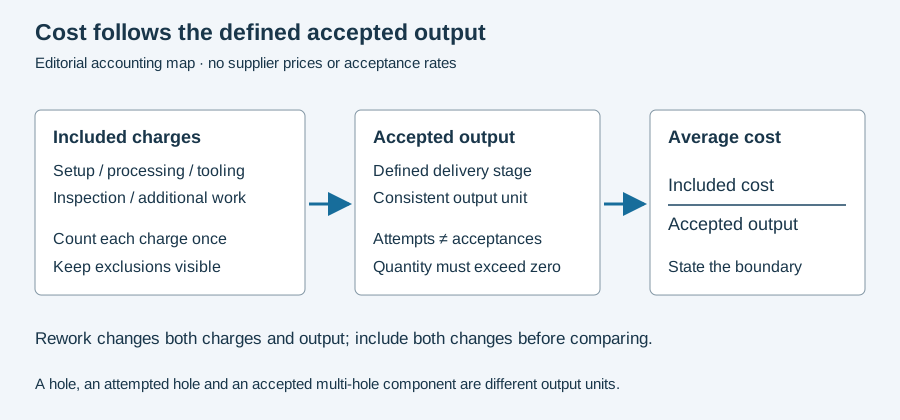
Our route comparison includes loading, support, transfer and measurement whenever they are required for delivery. Timing only material removal can miss occupied machine time or an external measurement stage. Define the start and end events before calculating a cost per accepted part.
Keep inspection available at the intended stage
If later assembly changes bore access, identify the planned observation before that change and the final evidence still required. An earlier report remains attached to its stage. It should not acquire a new acceptance meaning simply because the opening is no longer accessible.
The cost diagram and calculator below help compare identical delivery boundaries. Continue to the archive tubesheet case for its timing denominator, or railway machining for a concrete example where the longitudinal bore also provides later inspection access.
Revision note
October 8, 2026: revised the technical explanation and connected reading after source review. Original publication date and URL retained.