Marine component deep hole drilling can create a through bore in a drive shaft or hydraulic component. The original Breitenbach maritime service description names those applications alongside turning and grinding work on large round parts. This supplies a concrete manufacturing context without assigning every listed maritime component the same bore.
A through bore still needs a reference
A passage reaching the other end answers an access question. It does not, by itself, establish the specified relationship to external shaft features. Our suggested inspection map keeps the bore path, external reference and axial observation locations together.
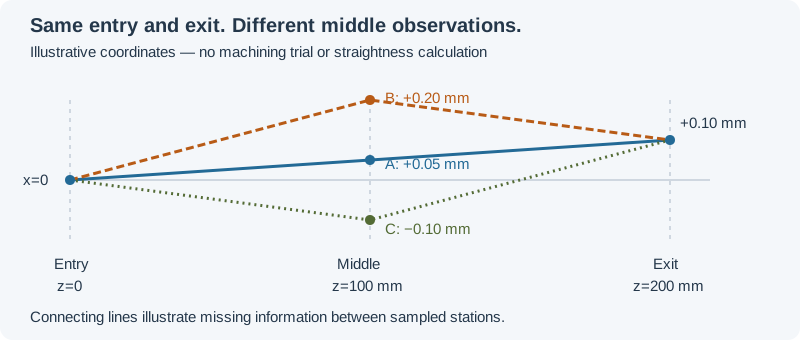
Where the specification relates the opening to an external seat or other feature, identify how that relationship is measured. An entry diameter and an exit diameter should retain their local meaning; they should not silently become evidence of the complete internal path.
The blank determines the manufacturing question
Breitenbach describes cast and steel parts, drilling with or without a retained core, and enlargement. Those are different starting conditions and removal tasks. A proposal for an existing hollow blank should name its incoming bore rather than describing every operation as drilling from solid.
For an annular-removal route, identify what happens to the retained core. Its potential value depends on its actual recovery and subsequent use. The manufacturing method alone cannot establish a material credit in a cost comparison.
External machining and bore reports need stage identity
The service description includes rough turning, finish turning and grinding. A bore report made before an external reference changes may describe a different relationship from the one required on the finished shaft. Keep that earlier report and identify the later observation needed.
This also clarifies a contractor’s delivered scope. A drilled opening, a finished shaft and an assembled maritime component are different outputs. Advertised service breadth does not show that every later operation is included in a particular order or price.
Handling belongs to feasibility
Show the actual incoming envelope and proposed support points when discussing a large round part. Machine travel alone does not describe space for loading, projections or measurement access. The supplier’s sector description is a lead for that discussion, not a verified handling study for the reader’s part.
The coverage diagram below and quality worksheet connect the bore to observed locations and external references. Continue to bore straightness for the path measurement, or trepanning for the material-removal distinction. Marine service approval, where required, remains tied to the actual component documents rather than inferred from a machining portfolio.
Revision note
October 8, 2026: revised the technical explanation and connected reading after source review. Original publication date and URL retained.