Defense-sector deep hole drilling appears in public machine and subcontracting portfolios. Applied Aerospace & Defense’s tubular-assembly page describes rotating and static hollow components, deep drilling and several other machining capabilities. A portfolio helps identify an offered service; it is not a completed acceptance record for every possible application.
Read each operation separately
The Applied page distinguishes drilling, boring, turning, honing and trepanning within its services. Those names describe different manufacturing tasks and outputs. A range stated for one operation should retain its operation label rather than being combined with the largest length or diameter advertised elsewhere.
This is especially useful when a supplier offers complete components. The breadth of the service list does not tell a reader which stages are included in a quoted job, which are subcontracted, or which surface was observed in a cited result.
A sector page is an attributed claim
UNISIG’s defense page presents equipment families for the sector. Its descriptions are manufacturer statements about applications and machines. They do not provide independent comparative production records or demonstrate acceptance of a particular completed product.
Our reporting approach keeps the named issuer beside the claim. If the source describes equipment availability, report that. If it describes an observed result, preserve the part, stage and stated basis. Do not turn the same sentence into a general industry tolerance or qualification.
Keep the record at the component level
A hollow-component machining result should identify the actual feature and material condition. Dimensional observations, surface observations and material examinations are different evidence categories. A report supporting one characteristic should not be broadened to every requirement of the component.
Where later work changes the surface, retain the earlier report’s stage. If the publicly available material provides only a capability description, acknowledge that scope once beside the claim rather than inventing a missing trial or a successful completed part.
What an independent comparison would require
A useful comparison would define the same delivered component, observation coverage and accepted-output boundary for both proposals. It would state which records were actually examined. Without those records, a public portfolio can support a description of available approaches but cannot support a ranking.
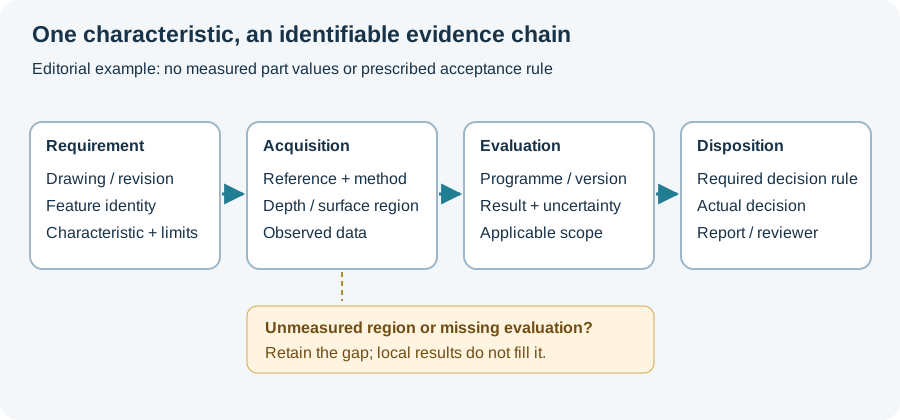
The evidence-chain diagram below and quality worksheet explain how a reported observation is tied to a characteristic and decision. Continue to the general BTA process page for its functional circuit, or the measurement guide for the difference between a measurement architecture and a complete acceptance record.
Revision note
October 8, 2026: revised the technical explanation and connected reading after source review. Original publication date and URL retained.