EV deep hole drilling needs a specific component and passage. A useful primary source is DE102022207609A1, published in 2024. Its description discusses near-wall cooling passages in thick-walled rotor shafts and proposes a multi-shell rotor construction as an alternative.
A drilled channel and a channel between shells differ
The patent describes inner and outer shells with cooling channels between them. Its background discusses deep-hole drilling challenges for passages in solid or thick-walled shafts. These are different ways of forming an internal flow path; they should not be represented as two drill settings for an unchanged part.
The patent argues that the proposed construction can improve manufacturing economics. That is an applicant’s argument, not an independently measured production comparison. It does not establish that deep drilling is uneconomic for all rotor designs or that the proposed shaft is used in a named production vehicle.
Keep the physical feature in the comparison
For a drilled proposal, the record identifies the bore, material and external reference. For a built proposal, it must also identify the surfaces and interfaces that form the passage. The observed feature and manufacturing stage change when the architecture changes.
Our suggested comparison starts with the delivered geometry and its required evidence. An accessible passage before assembly and the final internal arrangement are different observation states. Preserve the former report and specify which final characteristics still need evidence.
Automotive production evidence cannot fill a rotor gap
UNISIG’s automotive portfolio names transmission shafts and several other conventional automotive parts. It supports those stated examples, not a universal claim about battery cooling plates or every electric-drive rotor.
This keeps the application page grounded in an actual source. New EV designs may present manufacturing opportunities, but an industry trend cannot stand in for a component drawing, production record or thermal test.
Compare complete routes rather than isolated operations
A proposed architecture can move cost from drilling into forming, joining, assembly or inspection. Compare the same final delivery stage and accepted-output basis. The cost calculator can explore quantities supplied by the user; it cannot infer unknown joining yield or decide that a patent’s cost claim is proven.
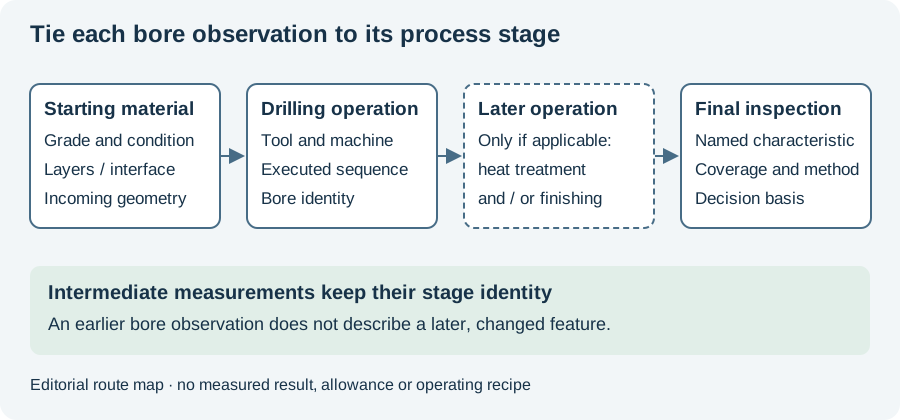
The material-and-stage diagram below keeps incoming construction, manufacturing and final inspection visible. Use the calculator for an explicitly stated scenario, then read method-cost comparison for the accounting boundary or the automotive production page for the cell timing and output record.
Revision note
October 8, 2026: revised the technical explanation and connected reading after source review. Original publication date and URL retained.