Geothermal deep drilling commonly refers to creating a hole in rock. Component deep hole drilling refers to machining a workpiece. The shared words should not merge the evidence. Quaise Energy’s July 22, 2025 announcement reports millimeter-wave drilling to 100 metres at a Central Texas field site.
What the milestone describes
Quaise describes rock ablation using a gyrotron and identifies granite in the field test. This is a developer-reported geological drilling milestone. It is not a gun-drilling or BTA trial in a metal part.
The release also discusses a higher-power system and a planned pilot power plant. Those statements retain their status as plans. A stated drilling depth is not evidence that the proposed plant is operating, nor does it establish a complete commercial well’s cost or energy output.
A manufactured passage has a different boundary
For metal equipment, the input is an identified workpiece and the output is a drawing-controlled feature at a stated manufacturing stage. UNISIG’s oil-and-gas component description provides examples of that boundary, including collars, fluid ends and other machined parts.
Those examples help explain component machining. The source does not establish that a particular named part was supplied to Quaise or used in a geothermal project. A supply-chain connection needs its own evidence and should not be invented from neighboring industry labels.
Depth figures need their physical context
A geological depth and a metal bore’s depth-to-diameter ratio describe different objects. The conversion tool can calculate a ratio once length and diameter are known. It does not make two drilling mechanisms equivalent or transfer a capability from one into the other.
When a source provides only depth, preserve that quantity. Do not infer the missing diameter, tested material, removal rate or acceptance criterion. This lets readers understand what was actually reported without turning one milestone into a complete specification.
Follow the appropriate next question
For a rock-drilling project, the next evidence concerns its demonstrated field conditions and development stage. For an equipment machining job, it concerns the actual part, passage and inspection record. Both can matter to geothermal development, but they require different sources.
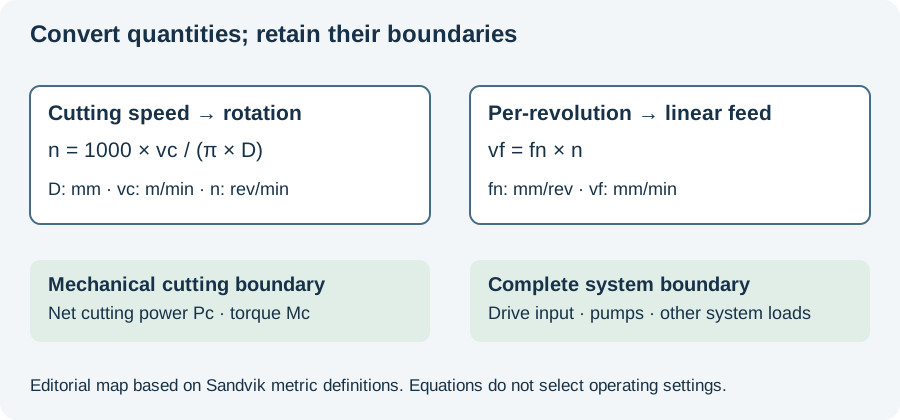
The quantity diagram below clarifies length, diameter and ratio. Use the conversion tool for identified dimensions, then read oilfield component machining for the workpiece boundary or the nontraditional-method overview for why a removal mechanism needs its own explanation.
Revision note
October 8, 2026: revised the technical explanation and connected reading after source review. Original publication date and URL retained.