A documented hydrogen-system deep-drilling example appears in BMW’s 2014 CryoComp final report. The heat-exchanger discussion on page 42 compares the existing deep-drilled block with a proposed composite-cast block. It is a historical development study, not a current general price list for hydrogen equipment.
The production assumption drives the comparison
BMW assessed raw material and manufacturing stages at several assumed production volumes. The report says the cast alternative became less expensive only above its modeled volume threshold, while the anticipated medium-term quantities did not justify selecting it. The deep-drilled alternative was therefore continued.
The useful lesson is the structure of the decision. A route’s economic claim belongs to a stated volume, complete manufacturing scope and assumed inputs. The report’s scenario cannot establish today’s casting or drilling price for a different component.
Geometry and joining remain in the route
The same discussion considers alternative connection and cover concepts. These involve changes to the component architecture rather than just changes in drilling speed. A comparison that removes drilling but adds another manufacturing or joining task needs to include that new task and its evidence.
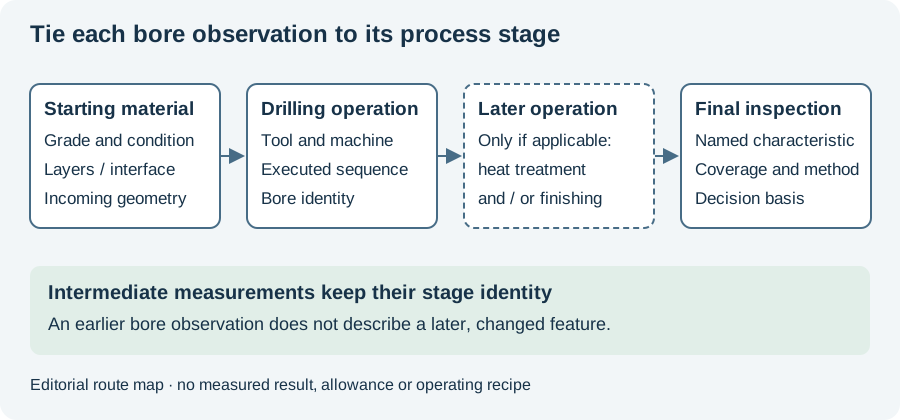
Our proposed route map starts with the actual material and construction. It identifies the machined feature, later operations and final observation stage. This makes a design change visible instead of presenting every alternative as the same bore made by another tool.
Machining evidence and service evidence differ
The report discusses component tests separately from manufacturing cost. An observed bore dimension does not establish the complete heat exchanger’s behavior. Keep the tested assembly, medium and conditions attached to a service result rather than applying it to every hydrogen-related metal passage.
A supplier’s ability to drill a material or reach a depth is useful machining information. It does not identify the component’s required leak, durability or other product evidence. Those requirements must be obtained from the actual controlled design and assigned to the responsible stage.
Use the case to ask a better cost question
The calculator below compares user-supplied or explicitly assumed route quantities on a common accepted-output basis. It does not import BMW’s historical price assumptions or infer an unknown yield. Record the volume and included operations with the result so the comparison can be reviewed later.
Continue to the method-cost guide for that accounting boundary, or secondary operations for preserving the inspected stage after additional work. The diagram keeps material, machining and final inspection connected without treating a historical hydrogen study as a universal qualification.
Revision note
October 8, 2026: revised the technical explanation and connected reading after source review. Original publication date and URL retained.