Wind-power deep hole drilling needs a named component. Shin-Il’s original energy page lists windmill shafts, turbine shafts and generator shafts as application examples. It also discusses heat-exchanger tubesheets. Those examples describe different workpieces rather than one universal wind-industry drilling specification.
A shaft bore needs its external relationship
For a shaft proposal, show the bore together with the external features required by the controlled drawing. A local diameter result cannot alone establish its relationship to an external seat or the complete path along the shaft.
Keep the incoming blank and manufacturing stage visible. A later external operation may change the reference used for final acceptance. Retain the earlier bore observation and identify the final relationship that still needs measurement.
Hydraulic finishing supplies another manufacturing question
ECOROLL’s cylinder explanation describes skiving and roller burnishing for hydraulic bores. It explains that a floating skiving arrangement follows the prior bore. That mechanism is relevant when reviewing a proposed hydraulic component route; it does not independently identify a named wind-turbine installation.
For an existing tube, the question concerns its incoming geometry and finishing. For a solid blank, an earlier hole-making stage is required. Keep those differences in the cost and quality record rather than comparing only the final finishing operation.
Do not infer turbine performance from a bore result
A machining report describes a physical component at its observed stage. It does not by itself demonstrate turbine output, service life or the behavior of an assembled system. Supplier language about suitable applications remains attributed to the issuer.
The useful engineering discussion stays with the actual feature: covered bore regions, external references, surface condition and the required delivered stage. An unresolved relationship should remain explicit instead of being hidden behind an industry-wide precision claim.
Compare routes with the same measurement scope
If one proposal includes additional finishing or an external measurement stage, identify that scope before comparing its cost with drilling alone. The final result and accepted-output boundary should match. Handling and access also belong to feasibility for a large shaft, rather than being inferred from nominal machine travel.
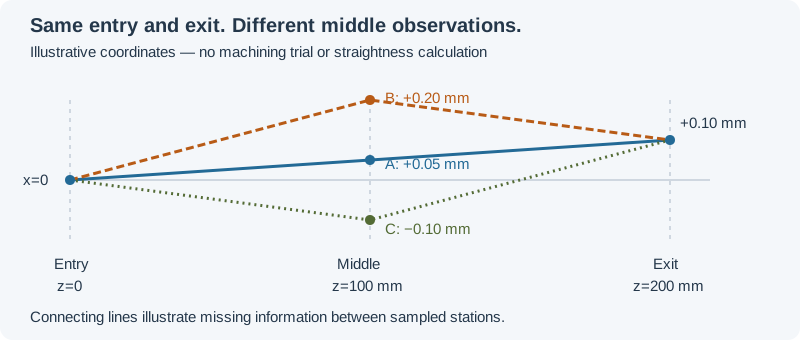
The coverage diagram below and quality worksheet connect the feature to its observed regions. Continue to the power/heavy-engineering page for shafts versus repeated hole patterns, or the hydraulic-cylinder page for incoming bore path and finishing. These paths let the reader follow the actual component instead of receiving a generic wind-sector checklist.
Revision note
October 8, 2026: revised the technical explanation and connected reading after source review. Original publication date and URL retained.