A detailed BTA simulation and an online process twin answer different questions. A May 2026 study by Zabel and Rödder provides a useful example of how to read the model’s physical scope before treating its predictions as a control capability.
A local cutting-and-pad model
The open-access paper models the outer cutting edge and first guide pad using the Coupled Eulerian–Lagrangian method. It treats the tool bodies as rigid and does not include a cutting-fluid model. The simulation investigates local bore-wall loads rather than the complete tool train, fluid circuit and machine.
That scope matters when interpreting a plotted field. A local surface-load prediction is not a forecast of every event during a full-depth drilling cycle. Define the proposed use first: examining a represented contact question is different from predicting an entire machine’s delivery performance.
Validation is not one accuracy label
The authors compare forces and subsurface temperatures with experimental or other numerical references. They report deviations, including a guide-pad speed dependence present in measurements but missing from the model. Its computation also takes days; it is not a demonstration of live cycle-by-cycle prediction.
For an engineering review, identify each output and its reference separately. A model can be useful for one quantity while leaving another poorly represented. Preserve a reported mismatch rather than summarizing all validation as “accurate.”
The paper’s dimensional text also needs care: section 2.1 names a 30 mm tool, while section 2.2.1 states a 60 mm experimental diameter. This page does not resolve that inconsistency or reproduce either as a settled setup dimension.
What an online-twin claim would additionally need
As an editorial evaluation criterion, an online claim should identify the physical configuration being represented, the measured inputs, update timing and a demonstrated prediction or decision. Those items need evidence from the actual implementation. They cannot be supplied by relabeling an offline finite-element study.
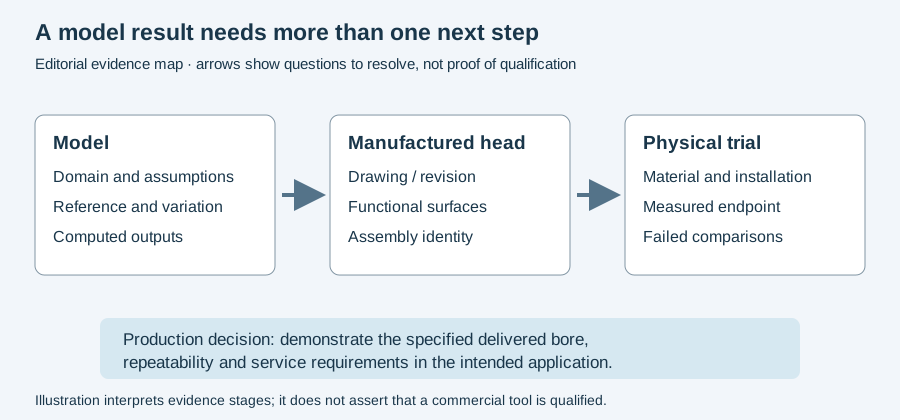
Use the evidence map below to separate computed outputs from a manufactured configuration and physical trial. The ejector model discussion offers a different numerical approach to a different question; it is not a method ranking. Continue to data acquisition when the proposed system depends on machine signals, and retain actual validation results in the case worksheet.
Revision note
October 8, 2026: revised the technical explanation and connected reading after source review. Original publication date and URL retained.