Cryogenic minimum quantity lubrication is a research topic for deep-hole drilling. Calling it a BTA retrofit, however, requires evidence about a BTA installation rather than an improvement reported for another tool and supply arrangement.
The project scope is narrower than the process label
The DFG GEPRIS description of project 452408713, read in German and English, concerns small-diameter nickel-alloy deep-hole drilling. It does not demonstrate a conventional BTA installation converted to cryogenic MQL. Its description reports that the proposed superiority of a single-phase lubricant/CO₂ solution was not confirmed; some mixtures showed delivery instability or phase splitting.
This is more informative than describing the project only as a promising cooling approach. A research hypothesis, the reported finding and the next investigation are separate statements. An unconfirmed hypothesis should remain visible in a technical interpretation.
Intended improvements are not completed outcomes
The continuation describes work on mixture behavior and a holder redesign intended to permit independent CO₂ pressure and mass-flow control. That intention is not a measured result from a finished commercial system.
For a proposed transfer, ask which unresolved question the new hardware is expected to answer and what measurement would demonstrate it. Do not turn an objective such as improved stability into an already achieved production capability.
Compare the functions that would change
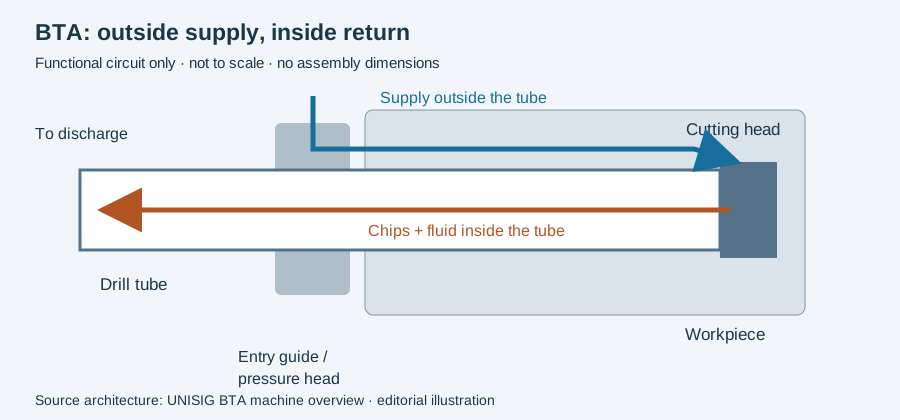
The BTA circuit below shows the conventional supply and inner chip-return relationship discussed in the process explanation. It is included to identify the existing functions, not to depict a cryogenic conversion. A proposal changing the supplied medium must address the complete installation and its chip-return requirement; the existence of cryogenic research does not document those interfaces.
Separate the proposed tool, medium-delivery arrangement, observed process behavior and inspected bore. A result from a different configuration can provide a research question, but it cannot supply the proposed assembly or prove its delivered output.
Use the case worksheet to record the reference and proposed configuration only when actual evidence exists. Continue to MQL and near-dry drilling for related research scope, or coolant-system investigation to define measurement points. The sources reviewed here establish no quantitative BTA tool-life or energy-saving claim.
Revision note
October 8, 2026: revised the technical explanation and connected reading after source review. Original publication date and URL retained.