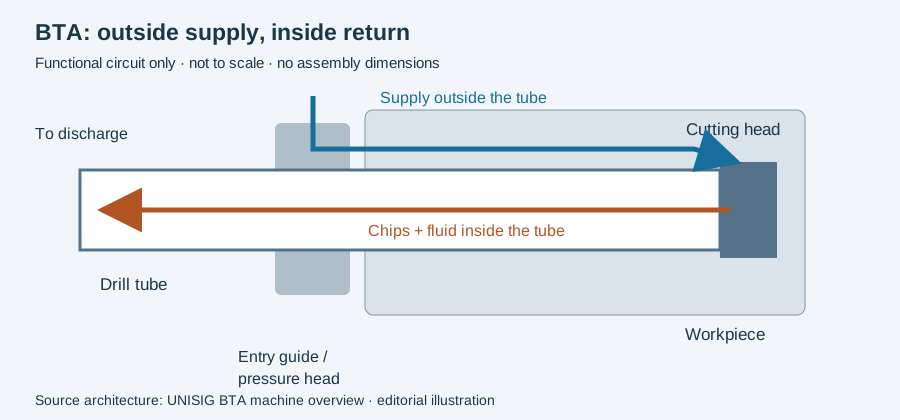
BTA drilling uses a single drill tube with different paths for supply and discharge. Understanding those paths is the starting point for identifying the process and discussing a complete installation.
Follow supply outside and return inside
The UNISIG machine overview describes external fluid delivery to the cutting zone and internal return of chips and fluid through the head and tube. Its installation includes entry guidance, a pressure head, tool support and a hollow spindle connected to discharge.
The sketch below shows those functions without prescribing a seal, head passage or machine dimension. A hollow spindle alone does not identify a complete BTA installation: the external supply, guided entry and internal exhaust interfaces must coexist in the proposed arrangement.
The cutting task still needs a name
Making a bore from solid is different from enlarging a bore that already exists. UNISIG’s tool descriptions also distinguish counterboring, pull boring and trepanning, which leaves a core. Sharing a machine family does not make their incoming workpieces or cutting tasks identical.
For an illustrative route comparison, begin with the drawing of the supplied blank. If it is solid, the route must create the opening. If it already has a bore, state that starting size and geometry before selecting an enlargement or finishing operation. A tool name copied from a catalogue cannot fill in a missing preceding operation.
Define the installation for the actual component
The tool train includes the head, tube, connections and drive arrangement. Preserve their identities alongside the component material, supplied condition, depth and end geometry. A nominal diameter does not document the required connection or the usable length of an assembly.
The acceptance endpoint is another part of the job definition. Separate bore size, geometric requirements and texture on the drawing, then identify how each is inspected. Selecting the process does not establish an achieved tolerance or determine whether a later finishing operation is needed.
Use the RFQ worksheet below to collect that component and delivery definition. Continue to the process circuit for the connected functions, or BTA-machine tooling for the distinction between cutting tasks. The process name becomes useful once those boundaries are clear.
Revision note
October 8, 2026: revised the technical explanation and connected reading after source review. Original publication date and URL retained.