A variable-peck cycle can make successive cuts shorter without measuring tool wear or chip accumulation. The difference matters when a program is called adaptive: a preselected depth schedule and a feedback-controlled intervention answer different process questions.
The documented progression
Haas UK defines I as initial peck size, J as the amount deducted on subsequent pecks and K as the minimum size. The mill reference excludes combining Q with I/J/K in its documented cycle. This is a named control feature, not evidence that a custom macro is required.
As an editorial arithmetic illustration, assume I = 8 mm, J = 2 mm and K = 4 mm. The intended increment sizes would be 8, 6, 4, 4 and so on. If the remaining distance to the final depth is only 3 mm, that remaining segment must be accounted for in the depth review. These assumed values illustrate a schedule; they are not selected cutting conditions or executable blocks.
The shrinking increments contain no observation of the current bore. Their suitability still depends on the drill, material, coolant arrangement and demonstrated process.
What feedback adds
In its January 26, 2026 ADC announcement, DMG MORI describes pressure, flow and load signals used in regulation of coolant supply and drilling strategy. That is a manufacturer’s description of a sensor-based system. It does not establish that a Haas I/J/K program provides the same function, or that an arbitrary load threshold can be added to a macro with equivalent results.
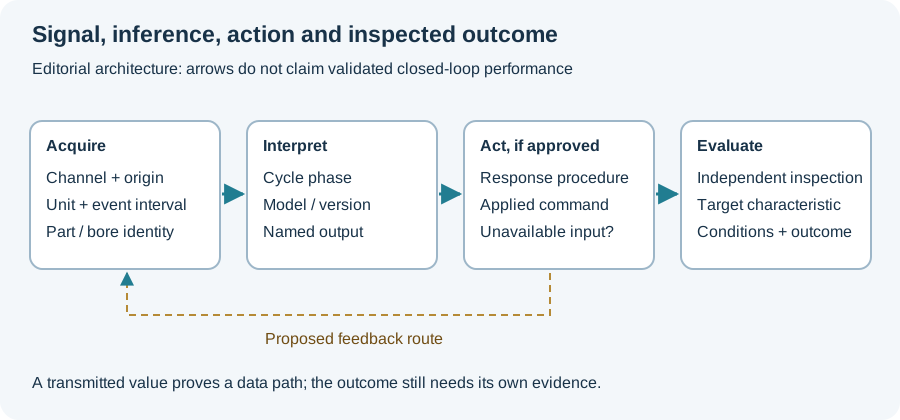
The feedback diagram below separates acquisition, interpretation, intervention and an independent outcome check. A proposed adaptive function needs to identify the measured input and approved response, not merely a changing parameter.
Resolve the simplest implementation first
For a conventional peck task, first determine whether the installed cycle already expresses the required schedule. A custom macro introduces its own variable state, evaluation timing and interruption behaviour. Those deserve a separate design review rather than being hidden inside a short example.
The incident worksheet helps retain the actual event when a schedule produces an unexpected motion. Read the macro article for evaluation timing; use the Haas cycle comparison to distinguish peck retraction from return level.
Revision note
October 8, 2026: revised the technical explanation and connected reading after source review. Original publication date and URL retained.