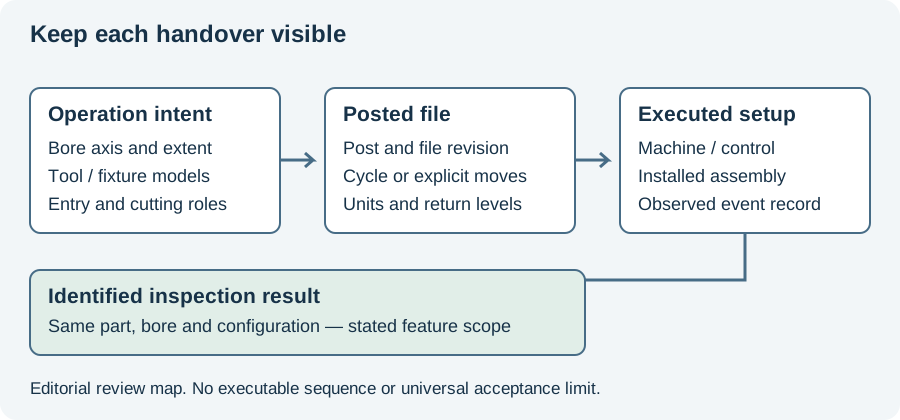
G73 and G83 describe different peck behaviour in the Haas milling reference. The return selected after a hole is another decision. Keeping those motions separate helps explain why two programs bearing the same drilling label can have different travel and clearance requirements.
What changes within the hole
The Haas mill manual describes G83 with constant or variable incremental peck depth. It distinguishes G73 through the peck retraction set by Setting 22. The Haas UK reduced-peck explanation identifies I as the first increment, J as the decrement and K as the minimum increment. The mill manual says not to combine Q with I/J/K in that documented cycle.
These meanings belong to the cited control. They are not a translation table for every manufacturer’s G-code. Nor does a peck-cycle label establish that repeated withdrawal belongs to the selected single-lip tool procedure.
Return level is a separate coordinate
The same Haas chapter identifies G98 as return to the initial Z level and G99 as return to the specified R level. This is different from selecting the size of a peck or its intermediate retraction. A program review should identify all three: cutting depth, intermediate motion and the level used before moving to the next hole.
For an illustrative review, imagine a fixture obstructing the lateral path at the proposed R level. The question is whether the approved return and transfer clear that fixture. Increasing an incremental cutting depth does not answer it. This is a geometric example, not a recommended clearance value.
Compare the posted motion
Fusion’s reference says a postprocessor can output a built-in cycle or expanded positioning moves. A CAM cycle name therefore does not tell the reviewer which blocks reached the control. Retain the posted file and compare its actual motion representation with the installed machine documentation.
Use the conversions tool below to reconcile speed and feed units once the machining conditions are established. It does not select a peck strategy. Continue to variable-peck logic for the increment calculation, or the control-reference article for the documents needed to approve the complete sequence.
Revision note
October 8, 2026: revised the technical explanation and connected reading after source review. Original publication date and URL retained.