A drilling cycle is assembled from several documents. The controller defines the language; the machine builder defines the installed equipment and commands; the tool procedure defines engagement and withdrawal; CAM and its postprocessor translate an operation into the program that will run.
Assign each question to its reference
| Question | Reference to examine |
|---|---|
| What does a peck or return argument mean? | Installed controller programming reference |
| Which command enables this coolant circuit? | Machine-builder documentation for the fitted options |
| How does this drill enter its guide and withdraw? | Selected tool’s application procedure |
| Which cycle or expanded moves were output? | Identified CAM operation, post and posted file |
The table is an editorial division of responsibilities. It prevents a programming example from silently supplying instructions for a different machine or drill.
A named control illustrates the distinction
The Haas milling chapter separates G73/G83 peck behaviour and G98/G99 return levels. Its meanings support a Haas-specific explanation. They do not establish an equivalent parameter set for Siemens, FANUC, HEIDENHAIN or another control.
Autodesk explicitly describes cycle output as dependent on the machine and postprocessor. Its generic diagrams explain motion roles, while the installed programming manual determines the actual command semantics. Compare the emitted file with that manual, including feed units and coordinate references.
A technology cycle adds a configuration dependency
DMG MORI’s January 2026 ADC release names initial machine families and Siemens/HEIDENHAIN support. That announcement identifies a product scope, not the command reference for every installed version. A technology-cycle name belongs in the configuration record together with the machine, software version and enabled mode.
For a changed job, identify which document or configuration changed before carrying over an earlier approval. A new post, holder or coolant option can leave the operation name unchanged while changing the actual review.
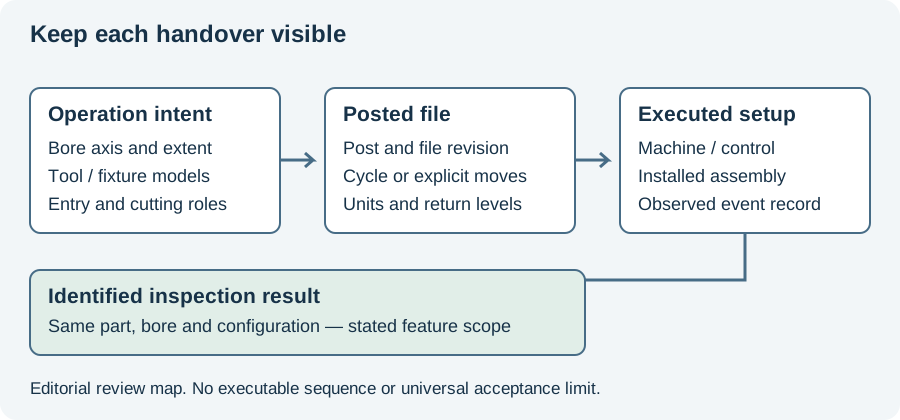
The program-evidence map below shows the handovers. Use the RFQ worksheet to assemble drawing and installation information when feasibility is still open. Once a sequence has been proved, the program-library article explains how to retain the relevant package for reuse.
Revision note
October 8, 2026: revised the technical explanation and connected reading after source review. Original publication date and URL retained.