A custom drilling macro earns its place when a required, documented sequence cannot be expressed adequately by the installed cycle. Before adding one, compare the intended behaviour with existing functions. Haas, for example, already documents variable-peck increments; a shorter program is not by itself a reason to replace that feature.
Variable scope changes the design
The Haas macro chapter distinguishes local, global and system variables. Its G65 discussion describes nesting of local variables and newly called local values that remain undefined unless populated by arguments. For the named control, a macro designer therefore needs to distinguish an omitted argument from a deliberately supplied value.
An editorial input review can ask what happens with missing depth, a nonpositive increment, a minimum increment larger than the first increment, or a target on the wrong side of the start point. The appropriate response belongs to the approved implementation. This article does not supply a portable alarm or variable assignment for other controls.
Evaluation can precede motion
The same Haas chapter explains that lookahead interprets macro expressions before the corresponding motion finishes. Its timed-output example demonstrates why variable changes written around a dwell need not occur at the times a reader infers from line order. This is a concrete reason to review evaluation timing when adding observations or responses to a drilling macro.
Follow the installed control’s documented method for that review. A generic instruction to insert G103 into every program would ignore the surrounding control configuration and motion functions.
Make the depth logic inspectable
An assumed variable schedule of 8, 6 and then 4 mm increments explains only the arithmetic. Review final-depth handling, the relationship between cutting and return coordinates, and which state persists between calls. A successful normal run does not describe the state after an interruption.
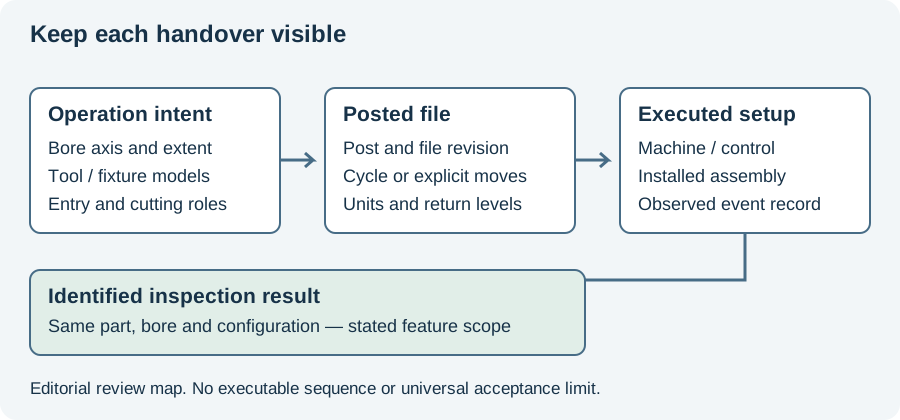
Retain the intended event sequence with the posted or manually authored program. Separate normal entry, cutting, withdrawal and the builder-approved recovery procedure. Attach the machine/control identity and the measured bore result to the released revision.
The diagram below follows that evidence chain. Record an unexpected event in the incident worksheet, preserving the original file before revision. Continue to the program-library page for version packaging or the variable-peck page for the simpler scheduled-increment example.
Revision note
October 8, 2026: revised the technical explanation and connected reading after source review. Original publication date and URL retained.