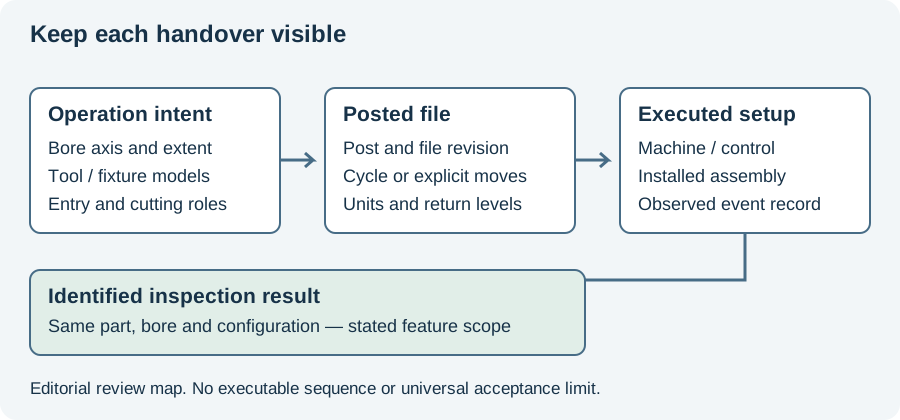
An angled bore is defined by the part. Rotary-axis positions describe how a particular machine reaches that bore. Five-axis deep hole programming needs to preserve the relationship between those two descriptions, including where the drill enters and how it leaves the guided region.
Keep the bore definition independent
Record the bore identifier, entry point, axis direction and required extent in the drawing’s coordinate reference. An editorial review can then ask whether the CAM setup and posted file still describe that same feature after a fixture or work-offset change.
In Fusion’s drilling reference, the setup WCS establishes the default tool orientation and a separate group can override it. The source also distinguishes four- and five-axis machining settings. This explains the importance of recording the operation’s actual orientation rather than inferring it from the machine’s axis count.
Separate positioning from penetration
Identify whether the approved drilling interval uses a fixed orientation or requires another configured motion mode. The transition into that orientation needs its own clearance review. A simulated access position does not establish a demonstrated long-tool entry through the intended pilot or guide.
Review the holder, drill projection, fixture and machine components represented in verification. For a changed holder, a prior clearance result refers to the previous assembly. Preserve the new assembly identity with the file that is actually posted.
Translation still matters after orientation
Autodesk’s cycle reference describes built-in cycles and expanded moves as post-dependent outputs. That dependency remains after a tool has been oriented. Check the coordinate references, feed interpretation and return motion in the emitted file against the installed machine documentation.
The distinction between reaching a bore and executing its drilling sequence gives a practical fault-localization rule. An unexpected rotary transition belongs to the orientation/transfer review; a wrong entry feed belongs to the later event comparison. Neither can be diagnosed simply from the label five-axis.
Use the incident worksheet below to retain the first divergent event and relevant file revisions. The diagram traces intent to actual execution and inspected output. Continue to the CAM article for location exclusions, or the program-library article for storing a reproducible released configuration.
Revision note
October 8, 2026: revised the technical explanation and connected reading after source review. Original publication date and URL retained.