Ultrasonic-assisted abrasive waterjet holemaking has an accessible experiment with a clearly identified workpiece: K9 glass. Qi and colleagues’ 2022 original paper combines a micro-abrasive water jet with a vibrating workpiece and compares physical micro-hole observations with a numerical model.
The workpiece vibrated beneath the jet
The apparatus has a jet-generation device, an ultrasonic platform and a three-dimensional motion platform. Alumina particles supply the abrasive action. The nozzle and workpiece arrangement differs from an ultrasonic-assisted rotating twist drill: there is no rotating cutting lip performing the material removal in this experiment.
This architecture is the first useful result of reading the methods. A common word such as “ultrasonic” does not identify which component moves, how material is removed or what evidence transfers to another setup.
The physical comparison had an on/off baseline
The researchers combine three jet pressures with three processing times, then test those nine combinations with and without vibration. They report at least five repetitions for each of the eighteen conditions and use microscope observations to compare the micro-hole profiles.
That supplies a direct physical comparison within the glass experiment. It does not establish a long metal-bore replacement for a gun drill. A favorable micro-hole depth response still belongs to the specified material, apparatus and observation method.
The amplitude description has a conflict
The apparatus prose states 20 μm vibration amplitude, while Table 2 states 10 μm. This revision retains the discrepancy rather than selecting whichever value makes a convenient operating table. The paper can be read for its comparison design without presenting an unresolved amplitude as a reusable setting.
The conflict also illustrates why a process diagram helps: it identifies the moving workpiece and jet without implying a dimensional specification. A schematic of the mechanism and an operating instruction are different artifacts.
Later sweeps used the model
After comparing numerical and experimental profiles, the authors change vibration frequency and amplitude in further calculations. Those sweeps are model results. They are not additional physical trials merely because they appear in the same results section.
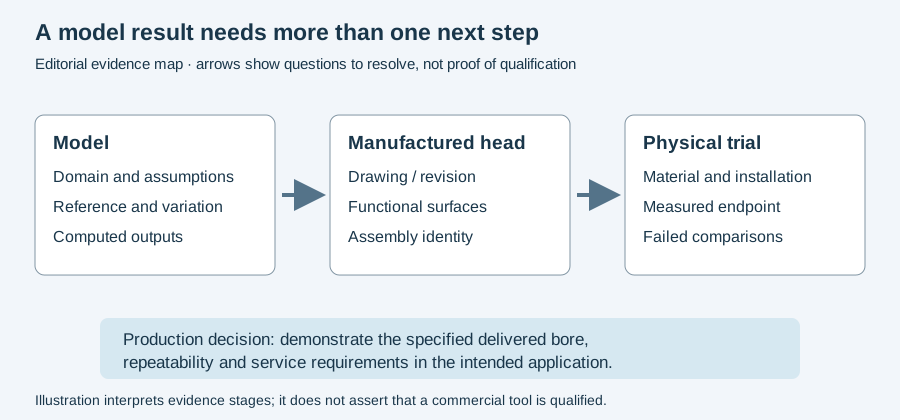
Our interpretation is to retain that sequence when discussing the study: physical observations assess the model under identified conditions, and the model then explores further conditions. A modeled preferred combination remains a candidate for a new physical check.
The diagram below follows that handover from calculation to application evidence. Use the bore-quality worksheet to define what a proposed sample would need to demonstrate. Continue to water-guided laser drilling for a different water-based architecture, or the unusual-material comparison for how actual depth and evidence type change the next reading.
Revision note
October 8, 2026: revised the technical explanation and connected reading after source review. Original publication date and URL retained.