Compare Deep Hole Drilling Costs by Production Route
Compare complete manufacturing routes on the same material, geometry, quantity and acceptance conditions.
Establish a common cost boundary
| Cost item | Information needed |
|---|---|
| Setup and changeover | Fixture/tool preparation and actual batch size |
| Machine time | Approach, cut, return, loading and tool changes |
| Tool consumption | Purchase/regrind/insert cost and demonstrated usage |
| Coolant and energy | Measured or explicitly estimated consumption |
| Inspection and finishing | Required operations and accepted results |
| Quality losses | Scrap/rework under the evaluated conditions |
| Investment | Installed cost, maintenance and realistic utilization |
Use one calculation structure
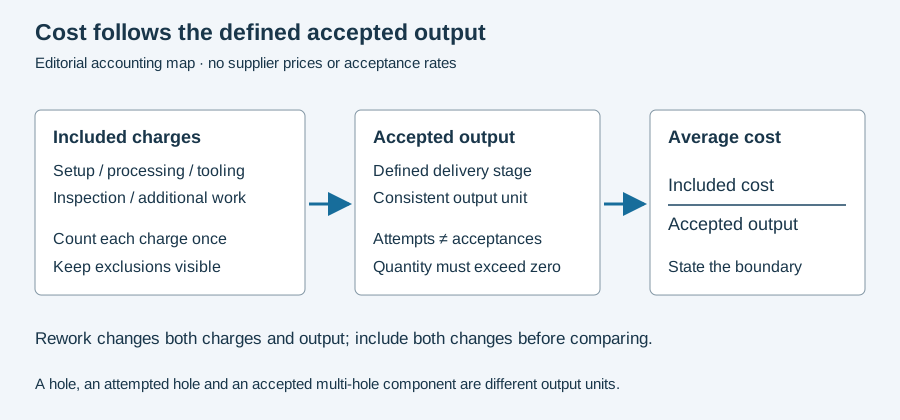
1Cost per accepted hole = total included batch cost / accepted holes
An assumed $900 batch cost with 100 accepted holes gives $9 per accepted hole. This arithmetic example is not a supplier price. State what the cost includes, and avoid counting capital both in the machine rate and as a separate charge.
Compare alternatives with evidence
Obtain comparable quotes or process trials. Use the method capability reference to screen technical fit, and the RFQ guide to prepare the same request for each supplier.
Model changes in demand, cycle time, tool life and accepted yield separately. Payback requires a positive, documented annual net saving; a generic volume threshold or fixed method multiplier cannot establish it.
A retained core changes the accounting question
UNISIG’s trepanning description identifies a retained core with potential reuse. Potential reuse is not a booked credit. Record the recovered material’s destination and any additional handling or machining needed before assigning value.
This is an editorial accounting interpretation, rather than a price claim from the supplier. Keep an assumed credit visible and calculate the route without it as well. The comparison then shows whether the decision depends on core reuse.
Examine one uncertain input at a time
For an arithmetic sensitivity example, assume included charges of $900. With 100 accepted holes, cost is $9 per accepted hole; with 90, the same included charges give $10. These invented values illustrate the denominator and supply no forecast of actual acceptance or production prices.
If tool consumption is also uncertain, change that input separately before combining scenarios. Otherwise a favorable result can conceal simultaneous assumptions about cycle, life and yield. Keep the part quantity and bore count distinct when a part contains several required holes.
The figure joins included charges to accepted output. Use the calculator to evaluate the recorded boundary, then continue to trepanning versus gun drilling for the core question or the cost-input RFQ article for matching quotation scope.
Revision note
October 8, 2026: revised the technical explanation and connected reading after source review. Original publication date and URL retained.