A deep hole drilling RFQ should identify the delivered feature, rather than requesting a price for “a deep hole.” Two quotations can share the same nominal diameter while covering different starting stock, operations and inspection.
Fix the common input and output
State the drawing revision, material condition, quantity and starting geometry. Identify the required depth convention, bottom or exit condition and bore characteristics. Keep part count and hole count separate if each part contains more than one feature.
These fields define our editorial quotation framework. They are not a universal supplier contract template. The purpose is to make a comparison interpretable before a total price is calculated.
Identify what the proposed installation includes
The German BOZA description lists functions at the BTA entry, including fluid supply, sealing and guidance. A quote for an installed operation should identify the applicable apparatus and workholding scope rather than leaving them implicit in the head price.
For another circuit, retain the corresponding tool, connector and supply arrangement. A tooling quote and a completed machining-service quote have different boundaries even if they mention the same process name.
Retain any later operation
UNISIG’s technical reference distinguishes enlargement, bottom forming and finishing from initial removal. If a quotation includes one of those stages, state its delivered characteristic and inspection. If it excludes the stage, the missing operation remains part of the route comparison.
This avoids interpreting the cheapest initial operation as the cheapest finished feature. It also explains why a quote may legitimately differ from another without either being a direct like-for-like alternative.
Ask for observations that answer the drawing
A reported local diameter, wall image and geometric evaluation answer different questions. Define the acceptance characteristics and observation coverage in the common request. If a representative sample is proposed, retain its material, configuration and inspected stage.
Do not silently replace unobserved locations with a general process-capability claim. A supplier’s published range can support screening while the job-specific requirement still needs its own evidence.
Bring the comparison into the tool
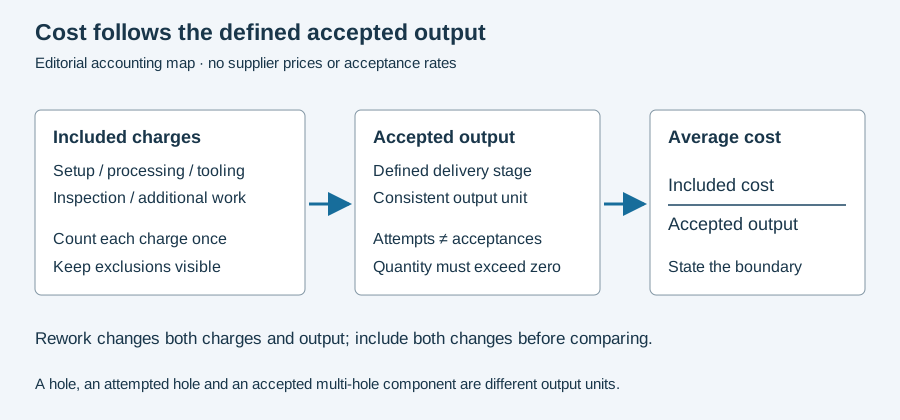
The RFQ worksheet below allows the common scope to be recorded and exported or printed. It does not send a request automatically. Once proposals use that scope, transfer non-overlapping included charges and the accepted-output unit to the cost calculator.
The accounting diagram makes the denominator explicit. Continue to route-cost comparison for sensitivity to accepted output, or equipment selection for the tool-to-machine interfaces. These connections keep quote preparation, technical compatibility and economic calculation as successive parts of one decision.
Revision note
October 8, 2026: revised the technical explanation and connected reading after source review. Original publication date and URL retained.