Ultrashort-pulse laser cooling holes involve the optical system as well as the pulse source. Fraunhofer ILT’s 2020 annual-report contribution describes a deep-drilling optical system developed through investigations of ablation at high fluence and high average power.
The report concerns a developed optical arrangement
The institute reports an optical design tool used to select components and process inputs for a desired hole geometry. It states a diameter range of 200–1000 μm and aspect ratios up to 20 for the described system in materials such as metals or ceramics.
Those are attributed research-program capabilities. They are not a promise that every diameter, material and geometry can be combined at the maximum ratio. The report also describes entrance shaping before or after drilling within the same processing step.
The pulse-family name does not specify the entire process
The report uses the broader ultrashort-pulse category. This page therefore does not rename every reported result as a femtosecond-only experiment. Fraunhofer’s current laser-drilling service description also separates percussion, helical and trepanning arrangements.
A cooling-hole proposal should identify the pulse regime, optics and motion together. A source rating alone cannot describe the shaped entrance or the interior profile.
A cooling feature has more than an opening diameter
Our application interpretation is to distinguish the entrance, interior passage and exit when defining inspection coverage. If the intended feature includes a shaped entry, its observation should remain separate from the narrower drilled passage. A longitudinal section can reveal one plane while leaving other parts of the shape unobserved.
The original report includes a turbine-blade processing illustration and a sectioned sample, but does not publish a complete component qualification dataset. Its low-damage discussion should not be expanded into an independently established fatigue result for an aerospace part.
Compare complete routes at the delivered stage
When comparing an optical route with electrode drilling or a mechanical route, retain any entrance-shaping and later finishing operations. The time for an initial opening and the time for the delivered feature are different accounting boundaries. They should not occupy the same comparison column without explanation.
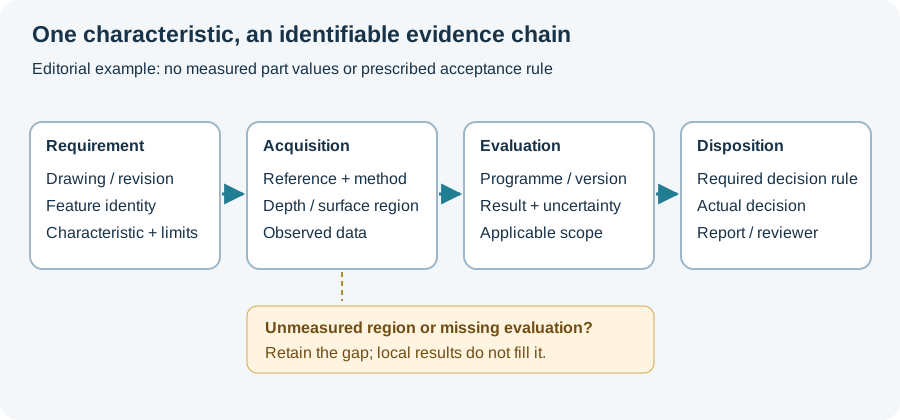
The bore-quality worksheet records the named characteristics and measurement coverage; it supplies no aerospace acceptance standard. The diagram below joins the requirement to covered observations and an identifiable decision. Continue to the EDM/laser comparison for the removal architectures, or measurement methods for the distinction between a local observation and an evaluated bore feature. These readings extend the optical-development report into the questions an actual cooling-hole application still needs to answer.
Revision note
October 8, 2026: revised the technical explanation and connected reading after source review. Original publication date and URL retained.