Assess depth capability
L/D is hole depth divided by hole diameter. For example, a 5 mm diameter hole 1,000 mm deep has L/D = 200. The ratio describes geometry; it does not independently determine process feasibility.
Distinguish three kinds of claim
| Claim | Evidence needed |
|---|---|
| Catalog capability | Exact tool or machine model, dimensions and stated conditions |
| Repeatable production capability | Comparable material, setup, quality results and process stability |
| A physical limit | Evidence that the limit applies to the mechanism, rather than one product |
Do not label a catalog maximum as a physical limit or invent a common production range from it. Use the method capability reference to distinguish process arrangements, then request a current capability statement for the exact tooling and installation. A specialist extreme-depth system cannot establish the same depth capability for another workpiece or machine.
What must fit together
- The tool and tube length must suit the full hole geometry and entry arrangement.
- Machine stroke, loading space and fixtures must accommodate both the workpiece and the tool.
- Guidance must control the unsupported tool length during entry, cutting and withdrawal.
- Coolant flow, pressure and filtration must support chip transport over the actual distance.
- The process must achieve the drawing requirements, not merely reach depth.
Ask for the complete capability envelope
Provide actual dimensions, material state, entry/bottom/intersection geometry and the inspection plan. Ask which conditions the supplier has already demonstrated, which need a trial, and what finishing is required. Compare full depth and absolute dimensions alongside L/D.
Spiral drills, trepanning and nontraditional processes
Specialist spiral-fluted tools can cover depths well beyond general-purpose drills, but their tool-specific pilot and cooling procedures matter. Trepanning must account for core handling. EDM/ECM/laser limits depend on their own removal and flushing mechanisms. Each option needs its own sourced product or trial evidence.
Continue with the selection decision guide.
An original optical example has its own geometry
Fraunhofer ILT’s 2020 deep-optics report reports a 200–1000 μm diameter range and aspect ratios up to 20 for the described optical system. These dimensions belong to that reported apparatus. They do not set the depth envelope of another laser or a mechanical method.
Likewise, UNISIG’s technical reference attaches generalized tooling examples to equipment context and says ranges vary by manufacturer. Comparing the largest ratio from each source would lose those qualifications.
Same ratio, different physical length
For an invented geometry example, 5 mm × 500 mm and 20 mm × 2000 mm both have L/D = 100. The absolute depth differs by a factor of four. The equality says nothing about tooling availability, machine space or inspected output; it only states the shared geometric ratio.
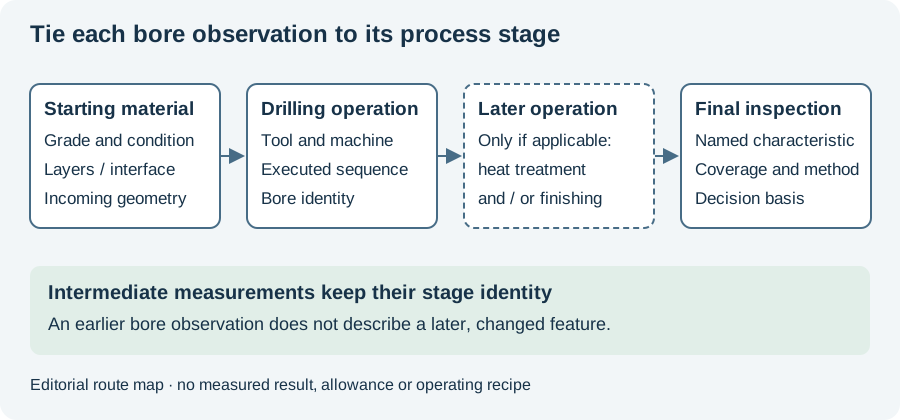
Use the RFQ worksheet to retain both actual dimensions and the complete requested feature. The route figure keeps observation stages visible. Continue to depth-dependent parameters for the operating-state question, or the optical article for the original apparatus and its evidence scope.
Revision note
October 8, 2026: revised the technical explanation and connected reading after source review. Original publication date and URL retained.