ECM, EDM and laser deep hole drilling are often grouped as nontraditional machining. The grouping is useful for finding alternatives, but the three processes do not have one common removal mechanism or one shared depth limit.
Three original descriptions identify different process elements
| Route | Element identified by the original source | What the proposal must locate |
|---|---|---|
| ECM | Anode workpiece, cathode tool and electrolyte gap | Electrode and electrolyte access |
| Hole EDM | Energized rotating tube electrode and flushing | Electrode operation and fluid path |
| Laser | Optical source and a specified drilling arrangement | Beam delivery and feature access |
The mechanism descriptions come from the Electrochemical Society, Makino and Fraunhofer ILT. The final column is our application interpretation. It identifies a question for the proposed feature, rather than a capability ranking.
Access means more than an entry opening
An accessible entry does not describe the complete processing zone. A proposal needs the actual electrode or optical arrangement, the workpiece geometry and the intended operation. An intersection or shaped entrance can change the task even if the nominal bore diameter remains the same.
This is why a published micro-hole example should keep its actual diameter and depth. The ratio helps compare geometry, but it cannot show whether another apparatus reaches the same internal region or produces the requested feature.
Keep removal and subsequent operations together
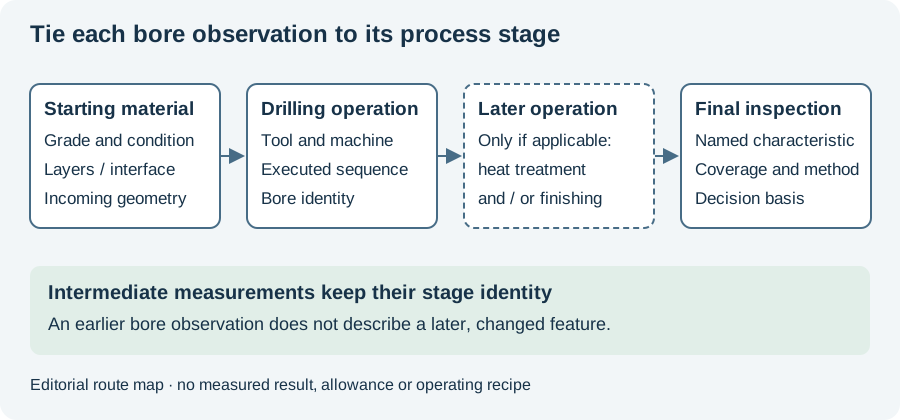
A process route may include preparation and later finishing. Include the operations that were actually used to obtain the inspected sample. A favorable final wall result cannot be attributed entirely to the initial holemaking step if another stage changed it.
The route diagram below preserves those stage identities. It does not imply that every nontraditional process requires the same finishing sequence; the later-operation box applies only to the actual route.
A comparison is strongest where the responses match
Choose the drawing characteristics first, then decide how to observe them. Geometry and texture can be complementary, while material integrity may need another examination. A process label or general “low damage” statement does not populate all those fields.
If the available evidence covers different characteristics, describe the mismatch explicitly. That still allows a useful comparison of mechanisms and evidence without pretending a head-to-head production test exists.
The quality worksheet records the feature and observation coverage. Continue to ECM cross drilling for a junction-access example, or the EDM/laser comparison for the tube-electrode and optical descriptions. Those pages develop two specific parts of this map and keep the complete delivered feature in view.
Revision note
October 8, 2026: revised the technical explanation and connected reading after source review. Original publication date and URL retained.