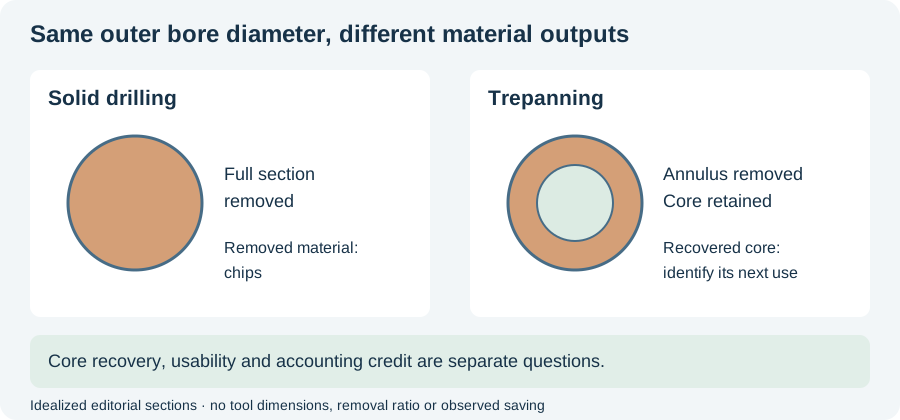
Trepanning deep hole drilling removes an annular region while leaving a solid core. UNISIG’s process description distinguishes that retained center from the material converted to chips during solid drilling.
The geometry explains the first comparison
The diagram below shows two idealized cross-sections at the same outer bore diameter. One identifies the full section for removal; the other separates the annular removal from the retained core. No cutter dimensions or production settings are specified.
This geometry explains what to compare before discussing economics. The retained core is an output that requires its own handling and intended use. Its existence does not automatically establish a credit against the bore’s manufacturing cost.
Named tools add assembly detail
The German BTA-Tiefbohrsysteme page lists Type 1030, 1031 and 1032 tools. It distinguishes connections and a version with additional back guidance. These are named assemblies; the process word “trepanning” does not identify every part needed by the installation.
The producer also describes lower cutting-power demand than solid drilling and potential reuse of the core. These statements describe its process offering, rather than a quantified independent saving for any material and diameter.
A blind bore changes the core question
UNISIG’s technical reference, page 2, notes that trepanning may be impractical for blind holes because of core-removal difficulty. This is a concrete application boundary to investigate, not a universal assertion that every core-drilling tool can make only through holes.
For the actual proposal, describe how the core is retained and recovered and what final bottom geometry is required. A nominal depth alone leaves both unresolved. Include a later operation when it is actually needed to deliver the feature.
Core value needs an identified destination
Our editorial accounting interpretation is to separate recovery from usable output. If a recovered core will become another part or a test sample, record the required condition and the operations needed to make that use possible. If its destination is not established, present any material credit as an assumption.
The cost-per-accepted-hole calculator can compare included route charges and accepted bore output. Keep the core credit outside the total unless its treatment is documented, and avoid counting it twice.
Continue to trepanning versus gun drilling for that matched accounting comparison, or through and blind holes for the delivered depth and bottom feature. These connections carry the removal diagram into the physical and economic questions that determine whether the core is useful.
Revision note
October 8, 2026: revised the technical explanation and connected reading after source review. Original publication date and URL retained.