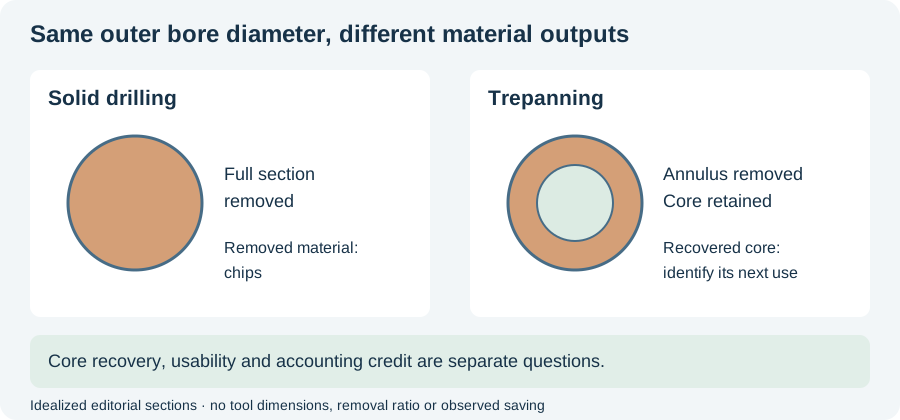
Trepanning versus gun drilling is most informative when the comparison describes the same required bore. Solid gun drilling converts the center material into chips; trepanning leaves a core. The difference creates an additional output, but does not by itself decide which route costs less.
Compare the removal task first
UNISIG’s trepanning description and the German BTA-Tiefbohrsysteme account identify annular removal and potential core reuse. The accompanying figure compares idealized sections at the same outer diameter.
That section is an editorial geometry illustration. It does not set a universal diameter at which trepanning becomes preferable, or a depth ratio beyond which it must be excluded. Published machine and tool ranges belong to their named configurations.
Keep the finished feature steady
Begin with the material condition, required bore geometry and inspection characteristics. A through bore and a blind bore can have different core-recovery tasks. UNISIG’s technical reference specifically notes the possible difficulty of removing a core from a blind hole.
If one candidate supplies the final bore and another requires an additional operation, include that operation in the route comparison. As-drilled output and finished output should not share an unexplained cost column.
Decide what happens to the recovered material
Core recovery, usability and credit are separate accounting steps. Our suggested record names the intended next use and any additional handling or machining needed. A recovered core that lacks an established use is not automatically worth the purchase price of fresh stock.
For an economic scenario, label an assumed credit and show the result without it as well. That makes the decision’s dependence on reuse visible. It also prevents an attractive material-saving claim from obscuring a route that fails the bore requirement.
Use accepted output in the denominator
Total included route charges divided by accepted holes gives the comparison unit used by the site calculator. Setup, tooling, processing and inspection belong in the total when the chosen boundary includes them. Do not count one charge again under a second label.
If a core is also a delivered product, specify how its value or allocated cost is treated. The calculator does not choose that accounting policy or predict acceptance. Its arithmetic uses the values the reader supplies.
The diagram explains the physical output difference; the calculator then evaluates a documented accounting boundary. Continue to the detailed trepanning article for the named tools and blind-hole question, or complete-route cost comparison for sensitivity to accepted quantity and included operations. Those readings support a decision without a fixed “large bore means trepanning” rule.
Revision note
October 8, 2026: revised the technical explanation and connected reading after source review. Original publication date and URL retained.