Water-guided laser drilling uses a water jet as part of the optical arrangement. Synova’s German tool-processing article describes a focused beam guided within a thin water jet by total internal reflection at the water–air interface.
Water has a specific role in this description
The account concerns Laser MicroJet processing and discusses diamond tool materials. The water-guided beam is a specific hybrid architecture. It should not be treated as any laser process to which water has been added.
The supplier describes benefits using “cold” and “clean” language and broad statements about avoiding processing problems. These remain supplier claims in a tool-processing context. They do not establish the absence of every wall defect in every long metal bore.
An abrasive waterjet removes material differently
In the accessible K9-glass experiment linked below, a water jet carries alumina abrasive particles and the workpiece is subjected to ultrasonic motion. That experiment has no guided laser beam. The fact that both setups use water does not make their depth responses comparable without further definition.
Our editorial distinction is to identify the removal mechanism before discussing a result: optical energy reaches the workpiece through the described guide arrangement in one case; abrasive impacts perform the reported erosion in the other. A jet pressure or hole photograph detached from that mechanism is ambiguous.
Process families also differ within laser drilling
Fraunhofer ILT’s laser-drilling description lists water-guided drilling beside percussion, helical, trepanning and ultrashort-pulse work. A portfolio of processes should not be collapsed into one system with all listed capabilities at once.
For a proposed feature, identify the actual equipment, nozzle/optical arrangement, material and required geometry. A demonstrated cutting-edge operation remains evidence for that operation; it is not a measurement of an unrelated enclosed bore.
What would make the bore comparison informative?
Keep the inspected positions and characteristic beside the sample. An entry image, a longitudinal section and a complete geometric evaluation have different coverage. If a later finishing operation is included, state whether inspection precedes or follows it.
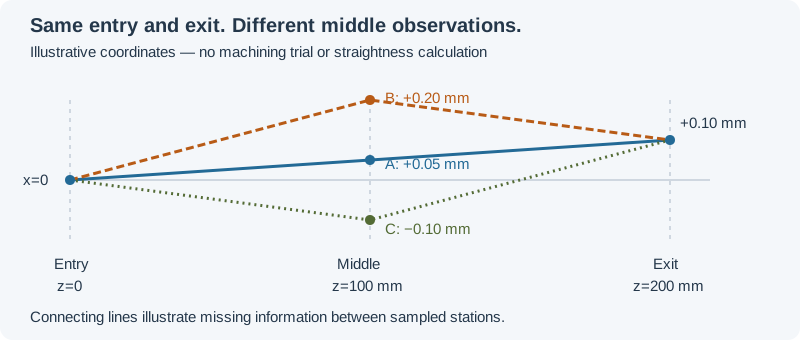
The coverage diagram below explains why observations at the ends leave the interior unresolved. Use the quality worksheet to define the feature and the locations that need observation. Continue to the abrasive-waterjet paper reading for its actual physical baseline, or ultrashort-pulse optics for another independently described optical arrangement. The connections help the reader compare processes by their apparatus and feature evidence, rather than by a shared word such as “water-assisted.”
Revision note
October 8, 2026: revised the technical explanation and connected reading after source review. Original publication date and URL retained.