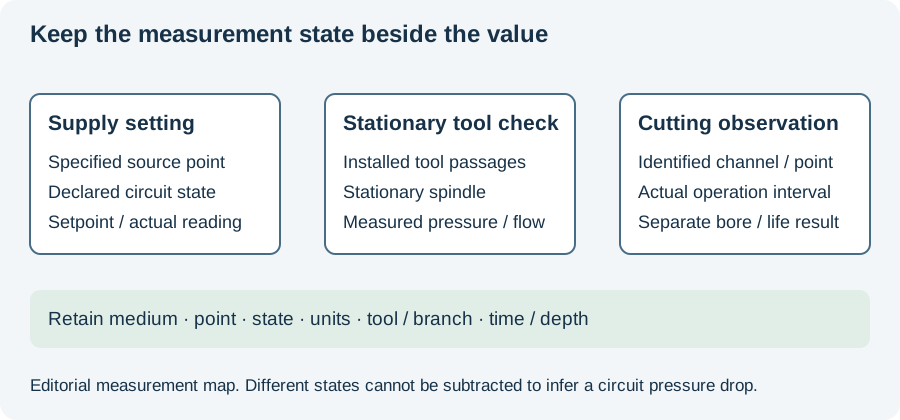
Coolant-pressure optimization in deep hole drilling requires more than a pump display. The comparison needs the fluid quantity reaching an identified tool, the operating state and the outcome the proposed change should improve. Higher pressure alone does not establish better transport or longer life.
Start with a defined measurement
Gühring’s original explanation describes pressure and coolant flow as relevant quantities and gives the PQ3000 as an actual-tool measurement device. Its specified check uses the installed tool directly in a stationary machine spindle.
This avoids replacing the tool’s passages with an unrelated test outlet. It also defines a limit: the result is a stationary machine/tool delivery measurement. Record cutting observations separately, including point, state, medium and sampling interval.
A complete pressure study supplies a useful distinction
The 2026 cMQL chapter investigates Inconel 718 with a 2 mm, internally cooled TiAlN-coated carbide twist drill at L/D 15. The apparatus varies CO₂ pressure and compares three ester-based lubricants. It measures delivery, wear, forces and temperature through separate procedures.
The authors report pressure-dependent changes in lubricant discharge and CO₂ flow. However, higher pressure does not significantly improve tool life for the lubricants examined. That result belongs to this cryogenic setup; it is not an oil-flood gun-drilling pressure table.
When a factor change also changes delivery
Changing pressure in that apparatus also changes CO₂ flow. This prevents treating the experiment as a universally isolated pressure effect. Its result can instead guide a better question: was the candidate pressure accompanied by a different delivery condition, and which outcome changed?
A September 30, 2026 TU Dortmund research task proposes repeating pressure experiments with lower-pulsation CO₂ delivery. It describes marked mass-flow fluctuations in earlier single-piston compression work and leaves open whether pulsation masked pressure effects. The proposed repeat is not a completed explanation of the earlier results.
Compare the intended outcome
For an installed flood-coolant system, retain the actual supply/return paths and inspect the bore and tool outcome against the same scope. Pressure and flow values from different operating states cannot establish a circuit pressure drop by subtraction.
Use the incident worksheet below when delivery changes unexpectedly. Continue to coolant troubleshooting for circuit tracing, or the cMQL article for the complete study’s experiment and follow-up question.
Revision note
October 8, 2026: revised the technical explanation and connected reading after source review. Original publication date and URL retained.