Cryo-MQL deep hole drilling combines cooling and lubricant delivery, but improving delivery does not necessarily improve the tool-life endpoint. The complete 2026 chapter by Sicking, Breer and Biermann illustrates that distinction for small-diameter helical drilling of Inconel 718.
The actual tool and experimental system
The open-access chapter describes a modified Körner CNC-607GK with internal CO₂/lubricant supply. A separate pump meters lubricant into liquid CO₂. The tool is a 2 mm Gühring ExclusiveLine Type 6412 TiAlN-coated carbide twist drill with L/D 15.
Three ester-based lubricants are compared: POE, V7 and S++. The source investigates CO₂ pressure alongside delivery, wear, forces and temperature. This is not a single-lip gun-drill or a BTA experiment, and it does not compare a nitrogen delivery system with CO₂.
Delivery and lifespan answer different questions
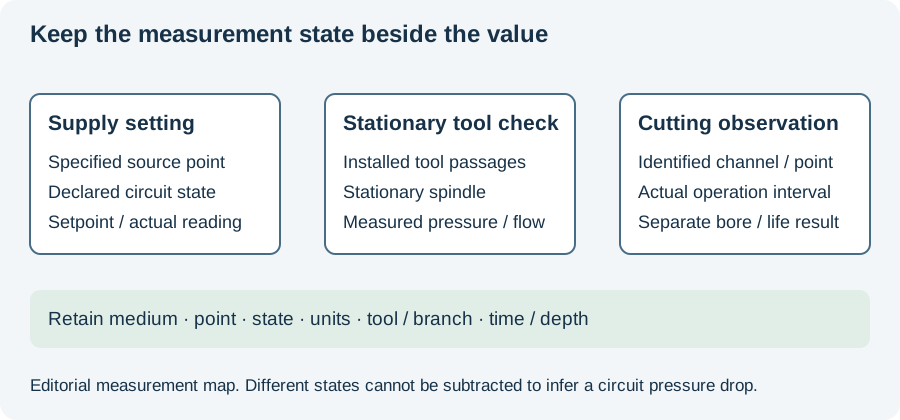
The authors measure lubricant discharge and CO₂ flow rather than assuming the dosing setting describes the amount arriving through the system. Discharge behavior varies with the lubricant and pressure. Increasing pressure also changes CO₂ flow, so it is not a universally isolated pressure intervention.
The reported tool-life endpoint includes wear, cutting-edge breakage or process failure. Life is expressed as drilled path length. Keep that endpoint when interpreting a claimed gain; metres drilled are not automatically accepted holes per edge.
The study reports no significant positive influence of increased CO₂ pressure on tool life for the lubricants examined. Differences between lubricants are more marked. The authors associate the performance of S++ with its additive content; that interpretation does not establish the same ranking in another tool or delivery architecture.
Temperature does not replace the life result
The temperature procedure uses a two-colour pyrometer with a fibre introduced into the workpiece. As drilling progresses, the measurement location shifts across the cutting edge because of the fibre arrangement. This is more specific than a tank temperature or a general machine thermal reading.
The source observes pressure-related temperature changes alongside the limited life effect. It therefore cannot support the shortcut “lower measured temperature means longer tool life.” Retain measurement location, tool state and the separate outcome.
A later German task leaves an explanation open
TU Dortmund’s September 30, 2026 project/bachelor-work announcement describes CO₂ pressure increases using a single-piston compressor in earlier investigations. It reports marked mass-flow fluctuations and asks whether pulsation masked a pressure effect.
The proposed work uses an accumulator-based control module to repeat pressure experiments with lower pulsation. Commissioning, delivery measurement, machining trials and comparison with earlier work are listed as tasks. The announcement supplies a research question, not results showing that the new arrangement improves life. Nor does it establish that every earlier published rig had the same condition.
Use the experiment to define a comparison
For another cMQL application, retain the actual tool, material condition, medium and lubricant formulation. Distinguish dosing, measured discharge and in-cut observations. Specify wear and bore-quality endpoints before comparing the settings.
The measurement-state diagram below helps keep the values separate. Use the technical-review proposal to define an expert review of the original source and the implementation question. Continue to thermal management for the temperature procedure, or sustainable coolant evaluation when the claim concerns resources per accepted output rather than lifespan alone.
Revision note
October 8, 2026: revised the technical explanation and connected reading after source review. Original publication date and URL retained.