Cryogenic and nanofluid coolant research should not be combined into one deep-hole drilling parameter table. A cryogenic carrier and a particle-containing lubricant describe different interventions. Evidence for one does not verify the other’s delivery behavior, tool compatibility or bore outcome.
An accessible cryogenic drilling example
The complete 2026 Inconel 718 chapter examines CO₂ and three ester-based lubricants using an internally cooled 2 mm twist drill at L/D 15. The experiment retains delivery, forces, wear and temperature as separate observations.
Pressure-dependent lubricant discharge differs between the oils, while CO₂ flow also changes with pressure. The reported higher-pressure conditions do not significantly improve tool life. This is a useful example of why a medium’s cooling capability and the actual machining result need separate evidence.
The study does not use a nanoparticle suspension. Its findings therefore cannot establish the performance of alumina, diamond or other particle formulations in the same drilling system.
What a nanofluid comparison needs to identify
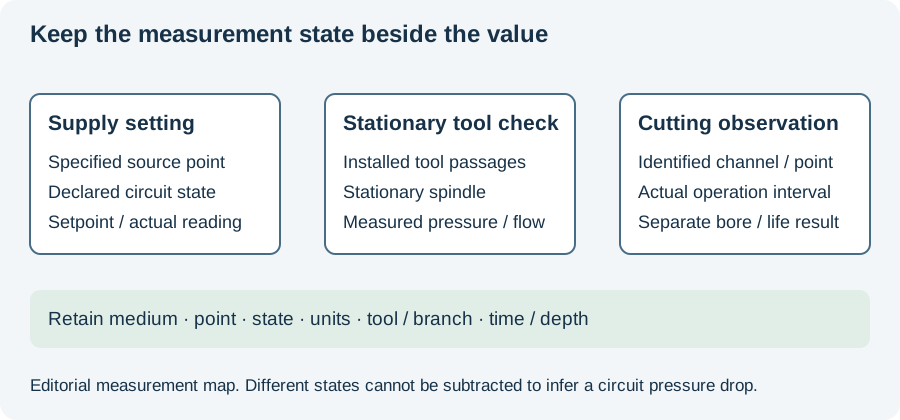
Treat the fluid as an actual formulation, not only the name of a particle. Retain carrier, particle specification, preparation and tested delivery arrangement from the original experiment. Link observations to the material’s supplied state, tool construction and actual hole geometry.
Those details are the proposed comparison boundary. This page supplies no particle concentration, pressure prescription or wear-reduction percentage: we have not verified a complete nanofluid deep-hole trial supporting such settings. A conventional or micro-drilling result needs its own depth and tool scope before it can inform a long-bore application.
Delivery stability is an active research question
The September 2026 TU Dortmund cMQL task proposes lower-pulsation CO₂ delivery and repeats of pressure experiments. It leaves open whether earlier mass-flow fluctuations obscured the pressure effect. This question concerns its described cryogenic research arrangement; it is not evidence about nanoparticle stability.
Do not relabel that proposed work as a demonstrated production improvement. The same distinction applies to a formulation’s bench properties versus measured tool discharge or a completed bore.
Compare resources at the same delivery stage
For a proposed alternative, state which resource is being compared: circulating fluid, net additions, lubricant dose, carrier consumption or system electricity. Add the accepted-bore result and required cleaning/finishing operations before drawing a shop-level conclusion.
Use the technical-review proposal to identify a specialist and the original formulation/experiment to be reviewed. Continue to the complete cMQL study for the verified pressure/life relationship, or sustainable coolant evaluation for resource boundaries.
Revision note
October 8, 2026: revised the technical explanation and connected reading after source review. Original publication date and URL retained.