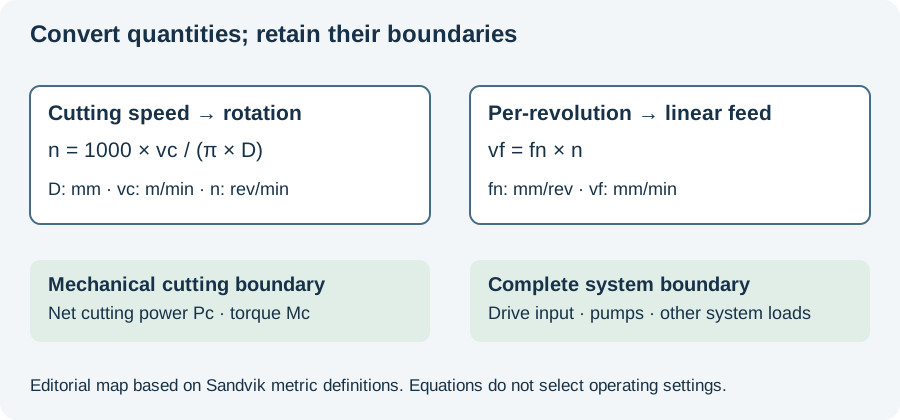
A deep hole drilling cutting-speed comparison starts with a speed definition and a diameter. Two tools running at the same rpm need not have the same peripheral cutting speed. Two settings with the same cutting speed need not deliver the same bore or service interval.
Convert the quantity before comparing it
The Sandvik metric sheet gives vc = π × D × n / 1000, with D in mm, n in rev/min and vc in m/min. Rearranging gives n = 1000 × vc / (π × D).
For an arithmetic illustration, assume vc = 60 m/min:
| Assumed diameter | Calculated rpm |
|---|---|
| 10 mm | 1,909.86 |
| 20 mm | 954.93 |
The chosen 60 m/min is not a material recommendation. The example shows why a copied rpm setting cannot preserve cutting speed across diameters. If both workpiece and drill rotate, establish the directions and relative rotation before assigning machine spindle speeds.
A published example includes interactions
The TU1 copper gun-drilling experiment varies cutting speed together with feed and fluid pressure for a 10 mm tool at L/D 50. Its fitted chip-response models contain interaction terms; the effect assigned to speed is therefore tied to the other selected factors and the sampled region.
That study examines chip-related responses, not a complete production route. Do not turn a reported model optimum into a claim that a given speed maximizes tool life or minimizes cost for all copper holes.
Separate elapsed time from the bore result
At a fixed feed per revolution, changing n changes feed rate vf = fn × n. A faster cutting segment can therefore be partly an arithmetic consequence of the setting. It still needs comparison with the required geometry, surface condition and tool endpoint.
Retain enough of the cycle to include entry, exit, return and any required downstream operation. Compare results from identified tool-service intervals; a fresh edge and an edge near its endpoint should not silently represent equivalent trials.
Route the evidence to the next decision
Use the converter below to preserve vc, diameter, rpm, fn and vf as distinct entries. The reference page supplies source-specific parameter context. If the proposed speed change is intended to improve chip evacuation, continue to feed selection and retain matched chip samples rather than judging the change from cycle time alone.
Revision note
October 8, 2026: revised the technical explanation and connected reading after source review. Original publication date and URL retained.