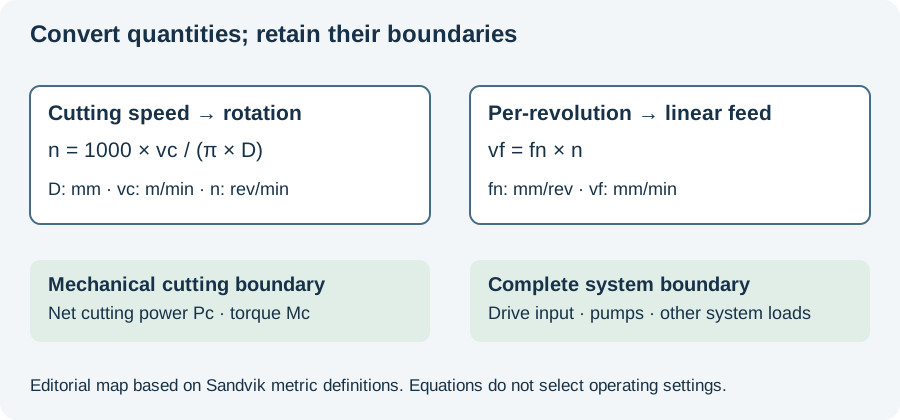
Deep hole drilling parameters combine cutting quantities, fluid-delivery conditions and machine actions. Treating them as three unqualified numbers loses the diameter, tool and measurement state that give them meaning. Start by identifying the quantities before choosing a value.
Four cutting quantities, two conversions
Sandvik’s metric formula sheet distinguishes cutting speed vc in m/min, spindle speed n in rev/min, feed per revolution fn in mm/rev and feed rate vf in mm/min:
1n = 1000 × vc / (π × D)
2vf = fn × n
Diameter D is in millimetres. These relationships convert a selected setting; they do not select a cutting speed or feed for a material. State which components rotate when using a relative cutting-speed calculation.
A tool recommendation has an address
The Botek single-/twin-flute catalogue separates tool families and material/diameter reference data. A row belongs to its named construction and material grouping. The entry guidance and installed support arrangement also matter; a matching diameter does not make two drills interchangeable.
If the job changes from gun drilling to BTA, revisit the source and assembly instead of retaining a method-free feed value. Link the parameter record to the tool revision, material condition and intended bore geometry.
Fluid supply is measured in a defined state
Gühring’s cooling explanation treats pressure and flow as relevant quantities. Its PQ3000 description specifically concerns the actual installed tool with the spindle stationary. That can characterize a machine/tool delivery arrangement, but an in-cut observation has a different state and purpose.
Record the medium, measurement point, operating state and units beside fluid values. A pump setting, stationary tool measurement and cutting-zone temperature do not represent the same variable.
Define what improvement means
The 2025 TU1 copper study varies feed, cutting speed and fluid pressure to model chip-related responses. That is a different objective from reducing cost per accepted bore or controlling a drawing characteristic. Its factor interactions also argue against a universal rule that one parameter is always the primary one.
For a shop comparison, choose the required bore result and resource boundary first, then retain the candidate setting and its actual observations. Use the converter below for quantities. Continue to the source-reference page to locate applicable rows, or optimization methods to understand what a designed trial can establish.
Revision note
October 8, 2026: revised the technical explanation and connected reading after source review. Original publication date and URL retained.