A deep hole drilling parameter quick reference is useful when it preserves where each value came from. Method, tool family, material condition, diameter and units belong beside the setting. Combining them into a method-free “steel” preset removes the information needed to judge applicability.
Locate the matching method evidence
| Method | Parameter reading | What to retain from the source |
|---|---|---|
| Gun drilling | Speed and feed source interpretation | Type, diameter row, material grouping and entry context |
| BTA | Parameter selection | Head construction, material/diameter scope and actual assembly |
| Ejector | Parameters and chip transport | Double-tube system, selected head and delivery arrangement |
These links lead to different technical questions rather than interchangeable numerical tables. Maintain the source edition and selected row when recording a starting value.
One verified row, with its scope
The German Botek catalogue, page 10, gives Type 113 reference data for the austenitic-steel grouping identified by nickel/chromium composition. In its 2.0–2.49 mm diameter row, feed is 0.005–0.007 mm/rev; the listed cutting-speed range is 30–40 m/min.
That row describes the named catalogue context. It does not qualify every stainless grade, tool coating or long-bore setup.
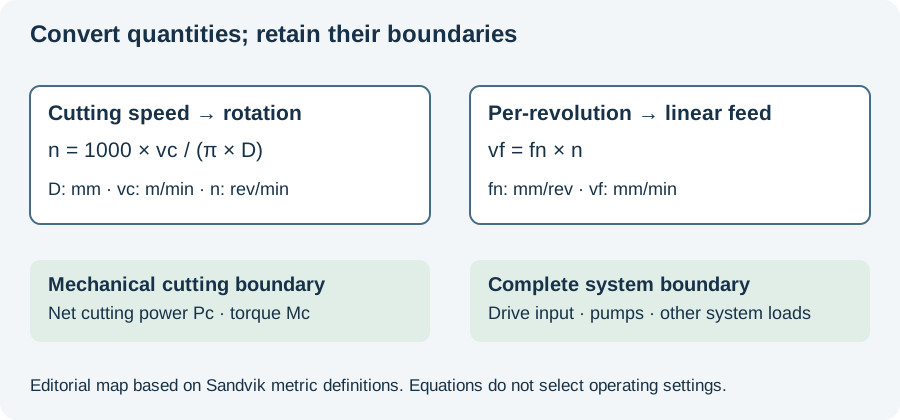
As a conversion illustration, select D = 2 mm, vc = 30 m/min and fn = 0.005 mm/rev. The Sandvik metric relationships give:
1n = 1000 × 30 / (π × 2) = 4,774.65 rev/min
2vf = 0.005 × 4,774.65 = 23.87 mm/min
The illustration converts a selected source-row value. It is not an approved program or a demonstration that a machine can operate at those conditions.
Research settings are another category
The TU1 copper experiment varies three factors for a 10 mm gun drill at L/D 50. Its experiment ranges and confirmed candidate address chip responses in that setup. Keep them labeled as research settings rather than adding them to a general production preset table.
Use the converter below to retain each quantity and unit. Continue to the overview for how cutting and delivery measurements fit together, or the full copper interpretation when the source of a proposed setting is an optimization study.
Revision note
October 8, 2026: revised the technical explanation and connected reading after source review. Original publication date and URL retained.