A deep hole drilling power calculation needs a defined cutting model and traceable inputs. The result below estimates cutting demand; it does not size a complete deep-hole drilling machine or its coolant system.
Metric cutting-power and torque formulas
The Sandvik Coromant drilling formula sheet gives the following metric relationships. Its German formula sheet uses the same quantities.
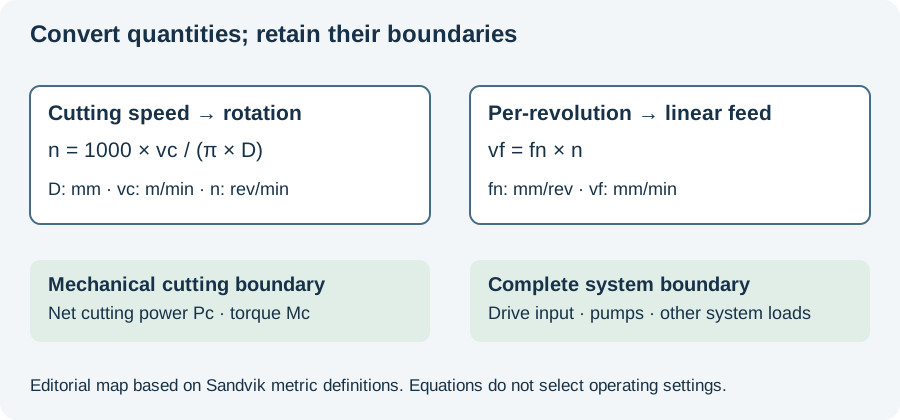
1n = 1000 × vc / (π × D)
2Pc = vc × D × fn × kc / 240,000
3Mc = Pc × 30,000 / (π × n)
| Quantity | Meaning | Unit |
|---|---|---|
| D | Cutting diameter | mm |
| vc | Cutting speed | m/min |
| fn | Feed per revolution | mm/rev |
| kc | Specific cutting force | N/mm² |
| n | Spindle speed | rev/min |
| Pc | Net cutting power | kW |
| Mc | Torque | N·m |
These are general drilling relationships. The source does not establish their accuracy for every gun-drill, BTA or ejector configuration. Keep that modelling limit visible when applying them to a deep-hole operation.
Worked arithmetic with assumed inputs
Assume D = 10 mm, vc = 60 m/min, fn = 0.02 mm/rev and kc = 2,000 N/mm². The kc value is an illustration, not a material-grade recommendation.
1n = 1000 × 60 / (π × 10) = 1,909.86 rev/min
2Pc = 60 × 10 × 0.02 × 2000 / 240,000 = 0.100 kW
3Mc = 0.100 × 30,000 / (π × 1,909.86) = 0.500 N·m
For a real estimate, replace every assumed value with a documented input. In particular, identify the source and applicability of kc. Giving an unverified coefficient more decimal places does not improve the estimate.
Compare the estimate at the operating speed
Use the configured spindle’s documented power and torque information at the proposed speed, with the applicable duty and operating conditions. A headline motor rating alone does not describe that operating point. The rpm and feed converter can check the speed conversion before that comparison.
Keep auxiliary demand outside this cutting calculation. Coolant pumping and other machine loads need their own data; whole-machine electrical consumption is a different quantity. A cutting estimate also does not calculate axial thrust, establish transient loads or demonstrate bore quality.
What belongs in the calculation record
Record the formula version, tool and material condition, diameter, speed, feed, coefficient source, excluded loads and machine curve reference. Compare an estimate with measured operation only after identifying what the measurement actually represents. Preserve differences rather than adjusting assumptions until the numbers appear to agree.
Carry these inputs into the equipment selection review and RFQ worksheet. They make the supplier’s machine proposal and the process assumptions easier to compare.
Keep measured demand within the same boundary
The Sandvik German sheet calls Pc the net cutting power and Mc the torque. Its units and relationships agree with the English metric sheet above. A drive’s electrical input includes a different boundary from this cutting estimate.
For an explicitly assumed mechanical comparison, 1 N·m at 1,000 rev/min represents P = M × 2π × n / 60,000 = 0.10472 kW. This follows the torque/power conversion; it does not establish a measured machine consumption or additional thrust demand.
The 2026 Inconel cMQL experiment measures forces through a dynamometer and identifies the acquisition separately from temperature and tool life. That separation matters when comparing modelled demand with an observed channel. A controller load percentage, mechanical torque and complete-system electricity should keep their own definitions rather than being presented as equivalent validation.
The quantity diagram below marks those boundaries. Use the converter for rpm/feed arithmetic and continue to equipment selection for the applicable spindle operating curve, or thermal management when the unresolved comparison concerns cutting-zone measurements.
Revision note
October 8, 2026: revised the technical explanation and connected reading after source review. Original publication date and URL retained.