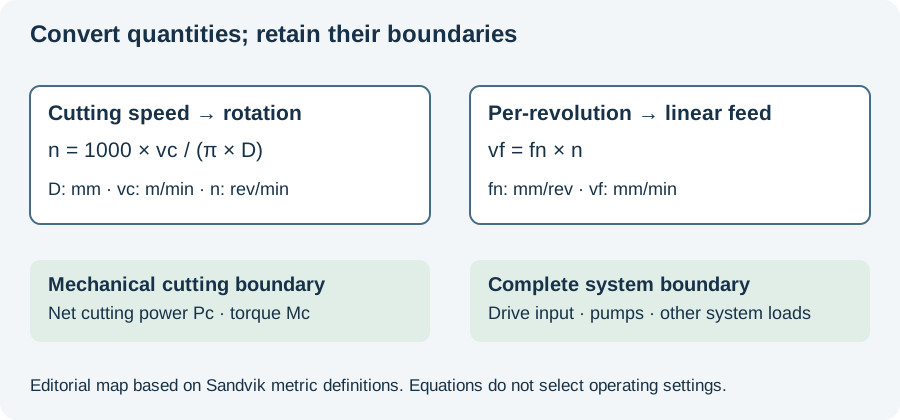
A deep hole drilling feed value needs its unit. Feed per revolution defines an advance associated with rotation; feed rate defines an advance per unit time. Confusing the two changes what the machine is asked to do and makes comparisons difficult to reproduce.
The conversion preserves two different quantities
The Sandvik metric drilling sheet gives vf = fn × n. With assumed fn = 0.020 mm/rev and n = 2,000 rev/min, vf is 40 mm/min. At 3,000 rev/min, retaining the same fn gives 60 mm/min.
Conversely, retaining vf = 40 mm/min at 3,000 rev/min gives fn = 0.01333 mm/rev. These are arithmetic examples, not recommended feeds. They show why “keep feed unchanged” must identify which quantity remains fixed.
Feed per tooth is another specification. Do not relabel a multi-edge experiment’s per-tooth feed as per revolution without the applicable edge count and source definition. The converter below uses feed per revolution.
What a chip study adds
In the 2025 TU1 copper experiment, the 10 mm gun drill produces 50 L/D holes. Feed, cutting speed and fluid pressure are varied in a response-surface design. The authors measure chip geometry and derive CCR and R; these responses differ from a simple count of chips or the delivered bore’s geometric acceptance.
Their analysis gives feed an important role within that experimental region and includes interactions with the other factors. The study does not support a universal instruction that increasing or reducing feed always improves evacuation. Keep the material, tool, medium and sampled settings attached to the interpretation.
Select from the applicable tool context
The Botek catalogue presents reference data by tool family, material grouping and diameter. The source row can provide a starting context for application review; a numerical match alone does not verify entry conditions, interruptions or the installed support arrangement.
For a trial, retain the actual fn and vf, the rotation arrangement and the tool-service interval. Associate chip samples with their depth/time interval and inspect the bore characteristics relevant to the proposed change. A sample collected after several mixed cycles cannot isolate one feed condition.
Use the quantity diagram and converter to resolve units first. Continue to the chip guide for sample interpretation, or the RSM study for an example of measured feed-response relationships and physical confirmation.
Revision note
October 8, 2026: revised the technical explanation and connected reading after source review. Original publication date and URL retained.