The gun-drilling FEM study by Sun and colleagues models Fe-Mn-Al-C low-density high-strength steel. Its publisher abstract reports relationships between cutting parameters, axial force, temperature and exit burrs. The practical value of those findings depends on what the model represents and how its outputs were validated.
What the publisher reports
The 2026 Manufacturing Technology & Machine Tool abstract describes a three-dimensional gun-drill/workpiece model. It reports increasing temperature with increasing feed and spindle speed, increasing axial force with feed and decreasing axial force with speed. It also reports different exit-burr trends as those factors vary.
These are the authors’ model findings for the stated material. The abstract’s proposed numerical setting is not adopted here as a machining recipe; the complete tool geometry, material law, contact and physical validation lie outside the readable record.
Separate model outputs from machining observations
A simulated burr, force or temperature is an output of the selected model. A measured exit profile, dynamometer trace or temperature procedure has a separate acquisition scope. Agreement needs the same geometry, location, conditions and quantity definition.
For a full model assessment, locate the constitutive data, mesh and refinement check, friction/contact assumptions, thermal boundaries and failure or chip-separation treatment. Then identify the experiments used for validation and whether they are separate from calibration. These are editorial assessment questions, not verified descriptions of this paper’s unseen methods.
Temperature requires a location
The complete Inconel 718 cMQL chapter gives a useful contrasting example of a physical measurement procedure. Its pyrometer fibre arrangement causes the sampled cutting-edge position to change as drilling progresses. That procedure shows why “cutting temperature” needs more detail than one number.
It does not validate the low-density-steel model. The materials, tool constructions and cooling conditions differ. Use it to define the comparison question rather than to supply missing model evidence.
Decide what the model can support next
A model may help choose a candidate for an approved trial when its calibration, domain and prediction error are known. It cannot by itself establish tool-life gain, acceptable bore geometry or a general exit-burr limit outside that domain.
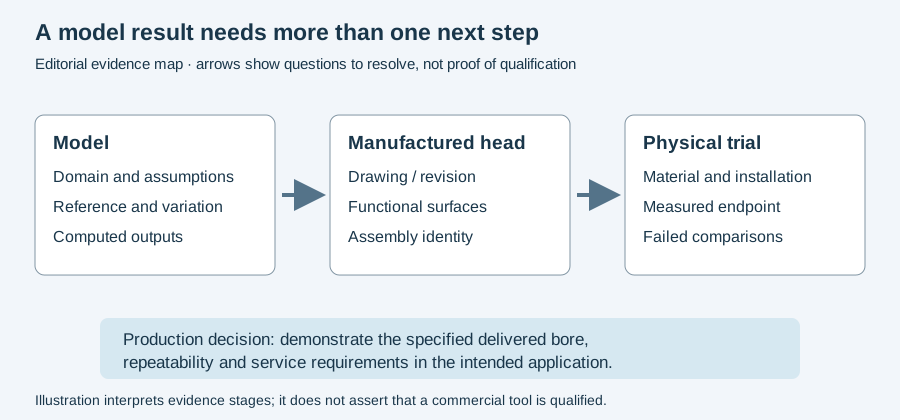
The model-to-trial diagram below connects documented assumptions with a physical test and an independently inspected result. Use the technical-review proposal to request an expert assessment of the model assumptions and missing validation evidence. Continue to thermal management for measurement scope, or optimization methods for the distinction between candidate selection and confirmed performance.
Revision note
October 8, 2026: revised the technical explanation and connected reading after source review. Original publication date and URL retained.