Machine-learning parameter optimization in deep hole drilling needs an identified dataset and measured outputs. A model learned from abrasive-waterjet holes addresses a different removal process from a gun drill or BTA head. The shared phrase “deep hole drilling” does not make their inputs transferable.
What the published waterjet experiment contains
The Scientific Reports study describes AL7075-T6 plate 12 mm thick and nominal 2 mm holes, giving L/D 6. Its three factors are waterjet pressure, standoff distance and abrasive mass flow. It reports 125 experimental runs in randomized order.
The text describes three factors at five levels but prints the factorial expression as 3⁵. Five levels for each of three factors instead gives 5³ = 125. Preserve the described factors, levels and count rather than repeating the inconsistent expression.
This is a jet-piercing experiment with a defined support and workpiece. It supplies no spindle-speed/feed table for metal-cutting drills.
A learned predictor and a search algorithm are separate
The article splits data 80:20 for training and testing, compares several predictors and applies evolutionary search to the selected model. The search evaluates model outputs; its candidate still needs physical validation under actual settings.
A withheld test subset answers a within-dataset prediction question. It does not establish transfer across machines, tool families or material states. For a new deployment, decide which changes must be represented in additional observations and which outcomes require independent inspection.
Read the response alongside its measurement
The study measures hole geometry at three axial planes and describes surface roughness measurements near the top. Those are different acquisition scopes. A predicted roughness response from that procedure is not evidence of the full bore wall’s condition.
Its abstract’s predicted/measured kerf-ratio values and stated percentage difference also do not reconcile by ordinary relative-difference arithmetic. We therefore do not adopt those performance numbers as a validated gain here. The article remains useful for examining the model workflow and the need to reconcile numerical reporting.
Connect recommendations to inspected outcomes
For a machining dataset, link every row to part/bore identity, configuration, tool-service interval and actual measurement coverage. Keep prediction error separate from physical acceptance and from the intervention that would implement the setting.
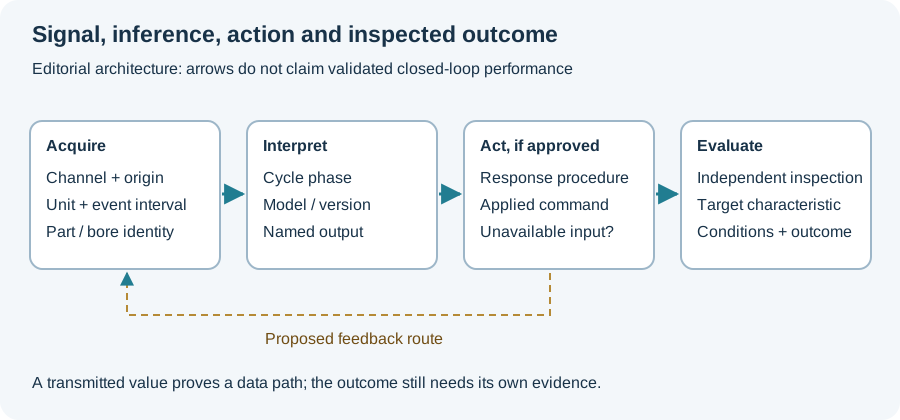
The feedback diagram below shows acquisition, interpretation, approved action and independently inspected outcome. Use the technical-review proposal to define a sourced expert review of the proposed model. Continue to optimization methods for the role of physical trials, or monitoring quality for the distinction between a signal and a measured bore characteristic.
Revision note
October 8, 2026: revised the technical explanation and connected reading after source review. Original publication date and URL retained.