Thermal management in high-temperature-alloy deep hole drilling needs a temperature location and a matching process outcome. Fluid supply temperature, a cutting-edge measurement and an inferred model temperature describe different parts of the process. Compare them only within an identified measurement and tool scope.
A defined cutting-edge procedure
The 2026 Inconel 718 cMQL chapter uses a 2 mm internally cooled carbide twist drill at L/D 15. Its temperature measurement employs a two-colour pyrometer; the fibre enters the workpiece and is cut as the drilling operation advances.
The fibre’s angled position causes the measurement point to move from the tool centre toward the edge with increasing depth. A reported temperature therefore belongs to that acquisition geometry. It is not a simultaneous map of every contact, chip and bore-wall position.
The paper also measures forces with a dynamometer and examines wear optically. Those observations provide different information from the temperature trace and should retain their own timing and tool-state references.
Cooling and lubrication can produce different outcomes
In that experiment, CO₂ pressure changes influence measured temperature and delivery conditions. The authors do not find a significant positive pressure effect on tool life across the lubricants examined. A lower thermal reading consequently does not settle the service-life question.
The lubricant comparisons likewise need their actual formulations and delivery arrangement. The paper’s explanation of an additive-related lubrication benefit is an interpretation of that setup, not a general thermal ranking of ester oils or coatings.
A simulated temperature has another evidence path
The Fe-Mn-Al-C gun-drilling model abstract reports temperature and force trends as cutting parameters vary. The accessible publisher abstract does not supply the full mesh, contact or temperature-validation procedure. Those trends cannot calibrate a thermal alarm or replace the measured Inconel procedure.
When assessing a model, identify where its temperature is evaluated, how heat partition and boundaries are represented, and what physical observation validates that location. Those are editorial evaluation questions rather than newly verified findings of the abstract.
Carry the feature into the inspection
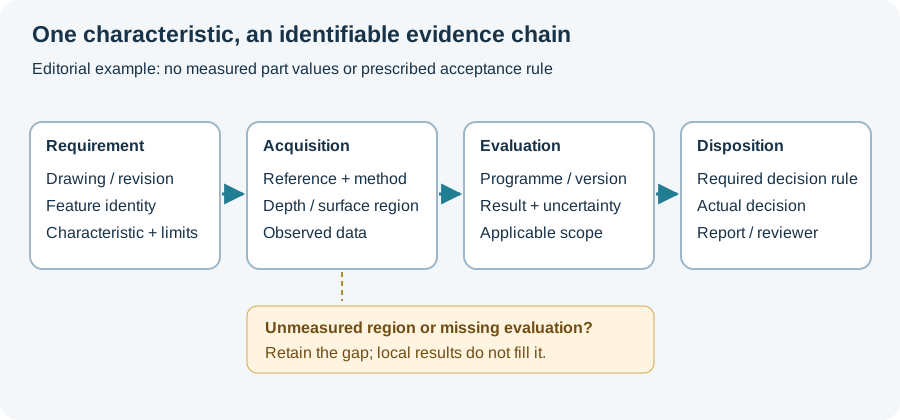
If a trial aims to improve the delivered surface, inspect the stated surface or subsurface characteristic using its own method and coverage. A force or temperature improvement is a process finding; it does not automatically describe roughness, residual stress or a local transformed layer.
Use the bore-quality worksheet below to retain feature, location and result. Continue to the complete cMQL interpretation for measured life, or the white-layer article when the required evidence concerns subsurface condition.
Revision note
October 8, 2026: revised the technical explanation and connected reading after source review. Original publication date and URL retained.