BTA drill-head regrinding and remanufacturing describe different possible service scopes. A quotation needs to identify what will be restored or replaced and what condition is returned. The word “remanufactured” alone does not establish a head’s remaining life or its performance on the next bore.
Begin with a serviceable construction
The botek BTA catalogue, pages 4 and 10, identifies Types 17, 18 and 20 as regrindable brazed solid-drilling constructions. It gives different connection arrangements within that group. This is a specific serviceability statement, not a rule that every BTA head can be ground and rebuilt in the same way.
The neighbouring BTA regrind article addresses the initial serviceability review. Here the question is the repair boundary and the returned assembly: which cutting elements, pads, body and connection are retained, serviced or replaced?
Separate operations within the offer
Edge regrinding, component replacement, body repair and assembly measurement are different deliverables. Preserve the received condition and proposed work before interpreting a returned report. If further damage changes the scope, record the revised disposition rather than hiding it under the original service name.
Botek’s gun-tool service page requests exact nose-grind information for tools from other makers. It illustrates the importance of defined geometry, but its listed gun-drill service must not be treated as evidence of an unspecified BTA reconstruction procedure.
What belongs with the returned head?
Retain the head identity, components supplied or retained, actual geometry checks and any use limitation in the returned documentation. A rejected head or replacement should remain distinguishable in that history.
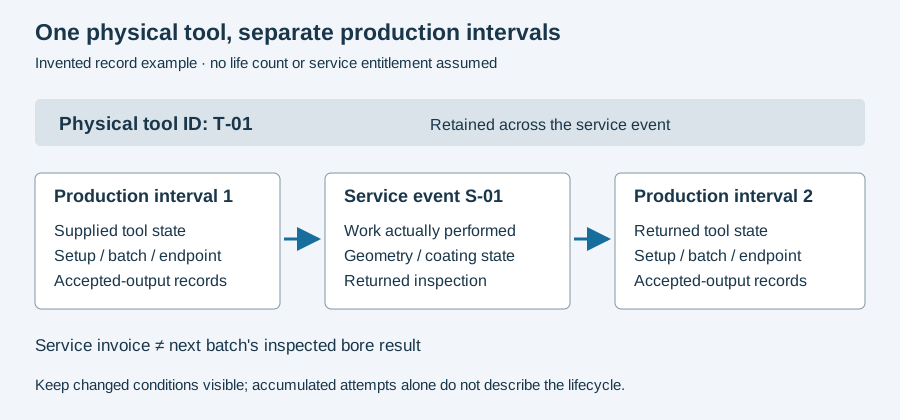
Receiving an assembly that matches the agreed checks is one finding. A subsequent machining interval has its own configuration, endpoint and bore inspection. Do not describe the receipt report as a demonstrated production-life result.
Account for the next interval
ZOLLER’s regrinding and life modules show how service costs and change reasons can be recorded in a tool-management system. The description does not establish the output of a particular remanufactured head.
For an economic comparison, include the declared service and production charges and retain accepted output separately from attempted bores. A lower repair price does not by itself demonstrate a lower delivered-bore cost.
The tool-interval figure below links service to subsequent production without assigning a repeat-service count. Use the RFQ worksheet for received condition, work scope and returned checks. Continue to tool inventory for identity across stock/service/production, or cost-per-hole analysis for the complete accounting boundary.
Revision note
October 8, 2026: revised the technical explanation and connected reading after source review. Original publication date and URL retained.