Deep hole drilling coolant filtration has an operating history. A fresh filter medium, a loaded medium and a medium being renewed are different states. KNOLL’s compact-filter description offers a concrete way to understand that history without assigning a universal micron rating to every drilling job.
Follow the return fluid
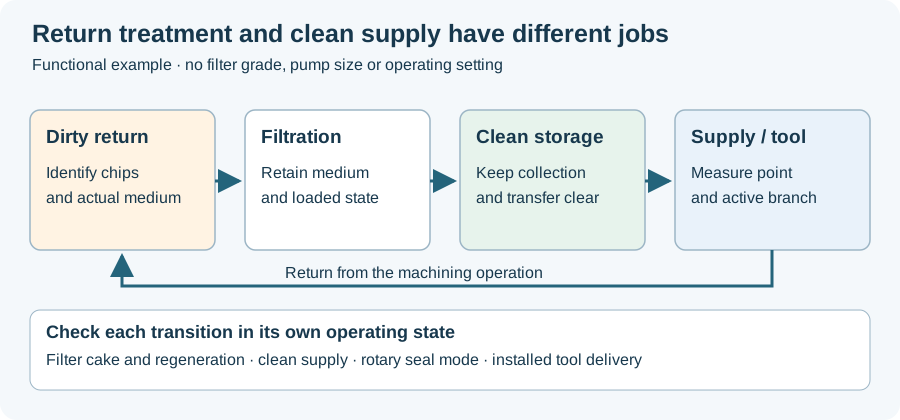
The original English KF description and German counterpart identify a dirty inlet, filter trough, fleece, clean tank and downstream supply pumps. Retained particles form a filter cake. Its growth raises resistance and the liquid level in the trough; the drive advances clean fleece when the configured level or time condition is reached.
This sequence gives each observation a place. Trough level, media advance and clean-tank supply describe filtration behavior. Tool pressure and flow describe downstream delivery. Treating one as the other can hide the transition at which a problem begins.
Cake formation is part of the process
The manufacturer describes the cake as participating in particle separation. Its increasing resistance is also part of the regeneration sequence. “Dirty filter” consequently needs a more precise description than a photograph of dark fleece.
For this named architecture, compare media advance and level behavior with the configured regeneration condition. For another filter, use its documented operating principle. The KF sequence does not describe cartridge replacement, a hydrocyclone or every back-flushing arrangement.
Separate component condition from bore quality
An observed change in filtration may justify investigating tool supply, but it does not identify the cause of a rough or deviated bore on its own. Keep the affected part, tool and timing attached to the event, then inspect the required characteristic independently.
Similarly, the term “clean tank” names a circuit function. It is not a measured cleanliness class or proof that the tool’s particle requirement is met. A filter-size label needs its test definition and applicable fluid conditions before it becomes a comparable specification.
Make the return and supply records meet
When investigating a change, place filter-state observations beside downstream values from the same operating period. Retain measurement points and active branches. A tank-side observation and an installed-tool stationary measurement have different scopes, even when both appear on the same maintenance report.
The circuit map below locates those functions. Use the incident worksheet to preserve an observed event. Continue to filter selection for the rating and acceptance statement, or the coolant-component map when the uncertain connection is between return treatment, clean storage and supply.
Revision note
October 8, 2026: revised the technical explanation and connected reading after source review. Original publication date and URL retained.