Deep hole drilling cutting-tool material selection contains two different descriptions: the substrate/construction and any coating on it. Calling a drill “carbide” does not identify its head assembly; naming a film does not define the underlying geometry or service state.
Begin with construction
The botek single-flute catalogue distinguishes solid-carbide tools, brazed carbide heads and constructions with separate cutting components. The BTA catalogue also separates brazed and replaceable-component families.
Those descriptions identify which surfaces and components belong to the tool. They do not supply a universal ranking of toughness, life or attainable bore quality across all material groups. Retain the actual tool family and geometry before comparing a cutting-material proposal.
Two actual coating descriptions
Oerlikon Balzers describes BALINIT OPTURA as a TiAlN-based PVD coating for drilling and reaming steel and cast iron. Its German description includes the same application positioning.
Ionbond’s 42 specification describes a diamond-like-carbon coating for aluminium alloys and sticky materials, with deposition compatibility covering carbide, HSS and brazed tools. That makes the substrate/film distinction explicit. The DLC designation should not be rewritten as a diamond cutting substrate.
These are producer descriptions, not a matched deep-hole trial establishing which coating wins on one bore. Their differing application scopes should remain visible rather than becoming a universal coating league table.
Compare the actual surface and service state
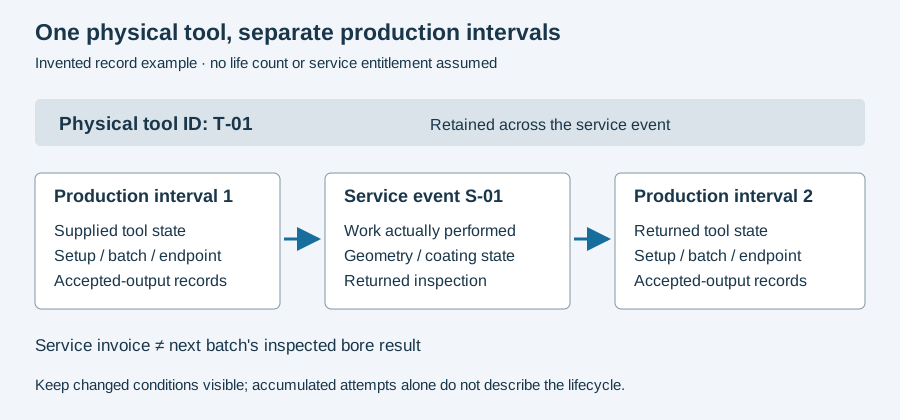
For a coating change, retain the tool geometry, edge preparation and surfaces treated. Identify whether the comparison uses a new tool or a reconditioned one. A returned regrind with a different edge and film is a changed tool state, not necessarily a coating-only experiment.
The service history also matters when interpreting an observed result. Link the installed tool configuration to its production interval and required bore inspection; separate the supplier’s capability statement from that result.
Choose the next evidence for the decision
For a production choice, the useful comparison retains supplied work-material condition, tool geometry, medium, hole geometry and defined endpoints. Life, chip behavior and the required bore characteristic can yield different findings. No complete matched trial in the sources above supports a generic choice for all nickel alloys, titanium or steel grades.
The interval figure below connects construction and service state to production. Use the technical-review form to submit a specific material/coating comparison with its original evidence. Continue to guide pads for the bore-contacting surface, or regrinding for the distinction between an edge service and a returned assembly.
Revision note
October 8, 2026: revised the technical explanation and connected reading after source review. Original publication date and URL retained.