Deep hole drilling tool inventory needs more than a count of available drills. A new tool, a returned regrind and a component awaiting assembly are different stock states. Each must connect to the tool configuration eventually used on an identified bore.
What a named software package records
ZOLLER’s GOLD description identifies modules for ordering, tool-use statistics, life management and regrinding. Its optional cost-per-part module combines defined life and quantities with purchase and regrinding costs. The German module account gives the same categories.
These are manufacturer descriptions of software functions. They do not establish savings at an independently verified deep-hole shop or show that every installation links the records to accepted bore inspection.
Keep a component separate from the assembled tool
A holder, cutting insert and complete drill may each have a stock identity. Retain the relationship between them when an assembly is released to production. A transaction recording an insert issue does not by itself establish which bore was cut with it.
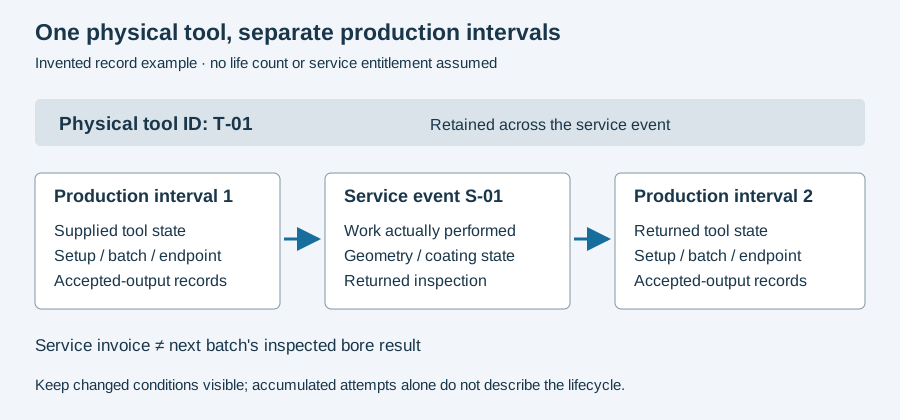
The site’s interval diagram uses invented tool T-01 to illustrate that relationship. Initial production, service and subsequent production stay connected, while each interval preserves its installed configuration and endpoint.
Service creates a new state within the history
Botek’s original regrinding offer lists eligible gun-drill constructions and requests exact nose-grind information for tools from other makers. It illustrates why the returned item needs more information than a generic “reground” label.
Record the service performed and returned condition beside the stock movement. If the supplier rejects an item, retain that disposition rather than counting it as production-ready. A replacement tool should not silently inherit the rejected tool’s life history.
Compare stock availability with production need
Order proposals based on minimum stock and tool-life status concern availability. An inspected production result concerns delivered quality. Those records should meet through job, tool and bore identity, without assuming one guarantees the other.
For costing, define the included charges and accepted-output unit. The optional supplier CPP description does not specify an accepted-hole denominator for every implementation. Use the site’s accepted-output calculator with your declared boundary; it does not forecast tool life or replenishment.
Continue to remanufacturing for the returned assembly record, or cost-per-hole analysis when the comparison involves more than tool purchase and service charges.
Revision note
October 8, 2026: revised the technical explanation and connected reading after source review. Original publication date and URL retained.