DMG MORI’s Adaptive Drilling Control announcement describes an integrated machining cycle, not a new cutting-tool material. Its value to a shop depends on the installed machine, supported control, sensors and process configuration. Two dated releases explain how the manufacturer’s description developed.
September 2025: gunDRILLING and coolant-flow adaptation
The September 22, 2025 English release introduces gunDRILLING alongside a separate gear-deburring cycle. Its drilling account describes continuous internal-coolant monitoring, automatic flow adjustment and feed adaptation within defined limits.
The release’s pressure and energy statements belong to that announced solution. They do not specify a pressure ceiling for every deep-hole operation or replace an actual tool’s delivery requirements. It provides no complete comparative dataset linking material, drill, bore geometry, repeated runs and accepted output.
January 2026: three ADC modes
The January 26, 2026 German ADC release distinguishes standard drilling, deep drilling and ADC Advanced for more complex gun-drilling tasks. It describes pressure, flow and load sensing, phase-dependent coolant control, and advanced options concerning cross-holes, pilot-hole offset and feed adaptation.
The initial machine scope includes named monoBLOCK, duoBLOCK, horizontal and portal/gantry series, with Siemens and HEIDENHAIN controls. That launch description does not establish availability on every earlier machine or an automatic retrofit route.
The chronology matters when specifying a system. Retain the supplied cycle version and installed options; matching a marketing name does not establish that a 2025 implementation has every function described in 2026.
Which evidence belongs in an application trial?
The manufacturer describes benefits in life, energy and quality. A shop comparison still needs its own baseline, production unit and inspection. Tool-life endpoint, system electricity and accepted bore characteristics are separate responses.
For a trial, preserve the original and adaptive configurations, actual changes made by the cycle and the identified bore result. If the cycle maintains delivery successfully but inspection rejects the bore, report both findings. The control trace should help explain the event rather than substitute for the required measurement.
Compare commercial control with research carefully
The 2022 sensor-tool paper demonstrates near-zone sensing and data transfer while assigning real-drilling feedback studies to future work. ADC’s commercial release describes another architecture. Neither source validates the other: their sensing locations and evidence stages differ.
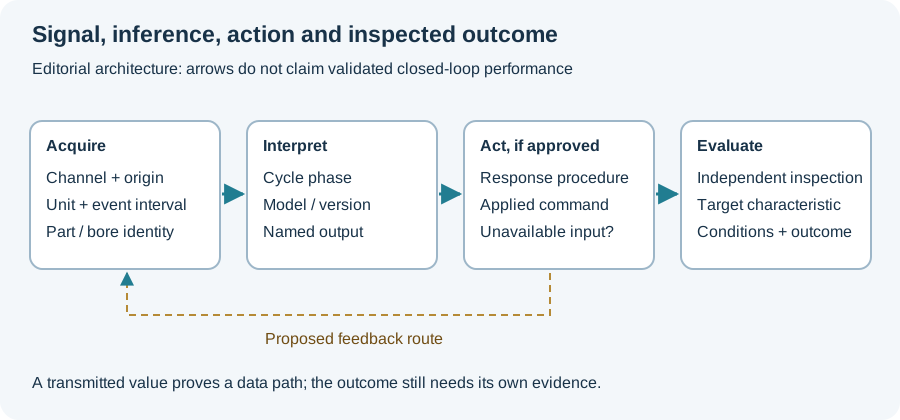
The monitoring figure below separates observations, interpretation and approved action from inspected output. Use the incident record for an unexpected intervention or result. Continue to smart tooling for sensor integration, or CNC handover for preserving the executed program and installed cycle configuration.
Revision note
October 8, 2026: revised the technical explanation and connected reading after source review. Original publication date and URL retained.