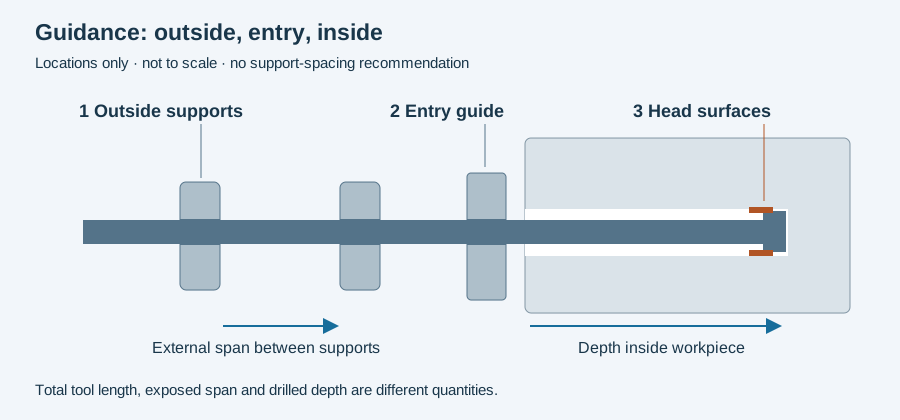
A 50xD deep-hole drill designation describes a product range, not a complete machining route. Diameter, flute construction, internal passages and entry arrangement still matter. A long carbide twist drill and a single-lip gun drill can carry similar depth ratios while using different geometries.
One actual 40D/50D range
OSG’s ADO-40D/50D product page identifies coolant-through carbide long drills. It describes chip-breaking gash geometry and a modified helical flute, and lists ADO-40D at 3–10 mm and ADO-50D at 3–8.5 mm.
Those diameter ranges belong to the named series. They do not establish that every diameter in another tool family is available at 50D, or that one trial qualifies every listed work material.
The page is a manufacturer’s capability description. Use the actual part number and operational guideline when developing the route; its headline alone does not supply the setup or inspection evidence.
Ratio, catalogue length and usable depth
For an explicitly assumed illustration, 300 mm divided by 6 mm is L/D 50. That arithmetic says nothing about usable flute length, holder projection, approach travel or the remaining length after service. Define which physical length the proposed tool designation describes.
Keep the actual hole depth and entry/exit geometry beside the tool code. A blind-hole depth, through-hole breakthrough requirement and clearance beyond the workpiece can demand different information from a total-length dimension.
Entry tools are part of the comparison
Gühring’s technical catalogue identifies pilot tools chosen for particular long-drill families, including point-angle and diameter-tolerance relationships. It does not make any short drill an equivalent pilot.
Compare the actual guide/pilot relationship rather than selecting an entry tool from nominal diameter alone. Avoid importing a gun-drill entry sequence into a helical long drill without the appropriate manufacturer’s instruction.
Compare routes at the inspected output
The single-flute catalogue describes internal supply and external-flute chip return for gun drilling. A long helical drill has its own flute and margin construction. The route comparison should include entry preparation, chip evacuation, required finishing and actual bore inspection.
The guidance diagram below locates the entry relationship without prescribing a clearance or sequence. Use the RFQ worksheet to retain the complete proposed envelope. Continue to bushings and workholding for the contact arrangement, or depth-ratio parameters for why L/D alone does not choose a feed reduction.
Revision note
October 8, 2026: revised the technical explanation and connected reading after source review. Original publication date and URL retained.