MQL deep hole drilling changes the delivery arrangement, not just the quantity displayed beside a flood-coolant pump. The proposed tool, lubricant and carrier route must work together. A small lubricant dose alone does not describe chip transport or what reaches the cutting zone.
An actual tool-development example
Gühring’s August 2024 cast-iron tool account discusses four-cutting-edge deep-hole tools. It separately identifies added chip-breaker geometry for small diameters and MQL applications. This is a manufacturer account of a named tool development; it is not evidence that any conventional flood tool can be converted by reducing its liquid supply.
The distinction helps define a useful comparison: retain cutting construction, chip geometry, material condition and tested hole geometry beside the stated medium. A cast-iron tool account does not qualify an unrelated nickel-alloy or long gun-drilling operation.
Follow carrier and lubricant separately
The Gühring technical description locates internal delivery and external flute return in gun drilling. For an MQL proposal, identify how the actual carrier and lubricant enter that path and how the selected tool is specified for it.
Keep lubricant addition, carrier supply and circulating flood volume as separate quantities. Their units and accounting boundaries differ. Multiplying a flood flow rate by operating time does not give net lubricant consumption, and a low dose does not prove adequate discharge through a long tool.
Check the interfaces as part of the system
Deublin’s coolant rotary-union descriptions include media-responsive arrangements for liquid, MQL and dry-air states. The series-specific behavior makes the machine interface part of the comparison. Compatibility of the tool alone does not identify the installed spindle interface or its approved operating sequence.
No universal air pressure, oil dose or depth limit follows from these sources. Preserve the actual delivery specification and evidence of the completed machining operation.
Compare output and resource use together
When considering a route change, inspect the required bore characteristics and include subsequent cleaning or finishing within the declared comparison. Record net additions and system energy separately from circulation or carrier flow. An alternative can change several parts of the production route at once.
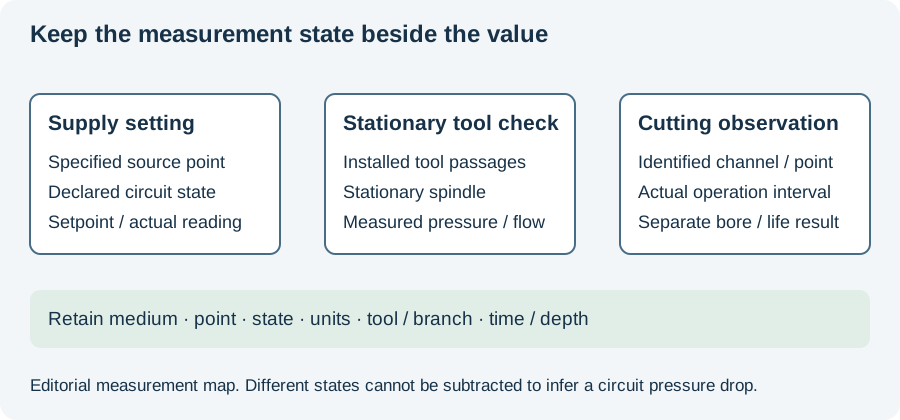
The measurement-state figure below keeps a setting, installed-tool check and cutting observation distinct. Use the RFQ worksheet for the proposed system and test scope. Continue to coolant sustainability for resource boundaries, or the cMQL research interpretation when the medium is a cryogenic carrier rather than the near-dry arrangement described here.
Revision note
October 8, 2026: revised the technical explanation and connected reading after source review. Original publication date and URL retained.