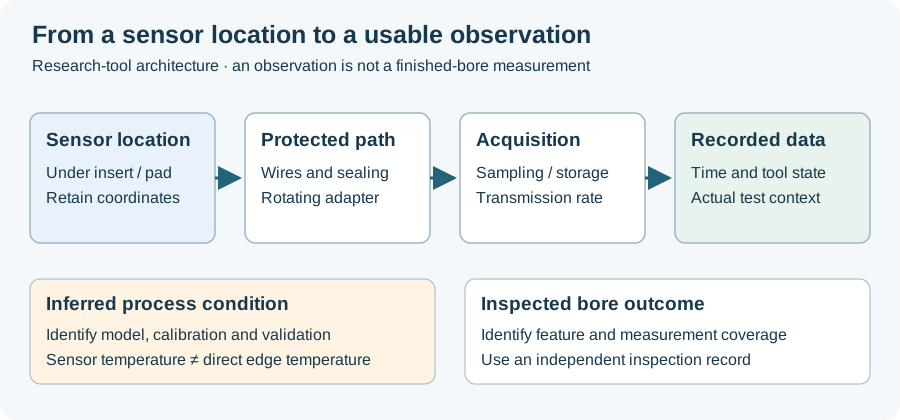
Smart tooling for deep hole drilling begins with a measurement location. A spindle channel, a sensor beneath a guide pad and a completed-bore inspection describe different parts of the process. The complete 2022 paper by Wegert and colleagues shows why the data path matters as much as installing the sensor.
Start with the actual research tool
The original paper uses an 18 mm Gühring EB 800 single-lip tool, 644 mm long, with an indexable cutting insert and four guide pads. Five resistance temperature detectors sit beneath the insert and a front guide pad; an accelerometer records motion at the head. Wires pass through the cooling channel to electronics in a rear adapter.
These are near-zone observations. The paper identifies prediction of cutting-edge temperature from the sensor readings as a model under development. An under-insert temperature is therefore not a direct measurement of the cutting edge, nor a measurement of the workpiece subsurface.
This location distinction is useful when comparing commercial descriptions of “tool temperature.” Ask where the sensor sits before comparing its number with pyrometry, a workpiece thermocouple or a simulation output. Their physical paths and response times may differ.
Follow acquisition through to delivery
The researchers separate vibration and temperature electronics. Their initial sequential wireless transfer is too slow for the desired vibration acquisition; buffered binary transfer improves it. Local SD-card storage offers another route to higher-rate acquisition.
The practical lesson is to retain three descriptions: what the sensor can respond to, how samples are acquired, and how observations reach the analysis system. A fast sensor or an advertised sampling rate alone does not specify the delivered data stream.
For a proposed production installation, check synchronization, missing data, storage and the link to bore identity in the actual configuration. These are editorial integration questions; the prototype paper does not establish their performance for every machine network.
Read the demonstration before claiming feedback
The article demonstrates temperature acquisition using external hot-air heating and evaluates acceleration on an idle rotating tool. Its conclusion assigns testing in real drilling and self-optimizing subsurface control to future work. Those demonstrations do not prove that a finished bore meets a residual-stress or geometric requirement under closed-loop production control.
A later research or commercial system must bring its own executed experiment. Preserve the operating phase, physical quantity and validation route rather than treating the word “smart” as a capability level.
A newer guide-pad proposal takes another route
The German patent application published in April 2026 describes thin-film sensor systems on guide-pad surfaces and transmission toward an evaluation system. It is a design disclosure, not an independent production trial. It adds a useful design question: how do sensing layers, their protection and their contact position coexist with the pad’s mechanical role?
The observation-path figure below joins sensor location, wiring, acquisition and recorded data. Use the technical-review proposal to define the specialist, review scope and original evidence needed to assess a specific tool architecture. Continue to the dated DMG MORI releases for a commercial control description, or process monitoring for the distinction between a signal, its interpretation and an inspected outcome.
Revision note
October 8, 2026: revised the technical explanation and connected reading after source review. Original publication date and URL retained.