A drill-head simulation is useful only when its computed question is clear. The ejector-head investigation by Rupasinghe and colleagues couples a fluid model with moving chips; its result should be read through that representation before looking at a promising image or percentage.
Fluid and chip motion are represented differently
The preprint’s model description uses smoothed particle hydrodynamics (SPH) for the fluid and a discrete element method (DEM) for chip motion. Selected chip geometries enter the model; thermal effects are omitted. A calculated transport result consequently does not supply a cutting-temperature prediction or demonstrate behavior for every chip shape produced by another material.
The practical reading question is which part of the proposed change falls inside that model. A change to a represented passage can be examined there. A claim about tool wear, for example, needs evidence addressing wear rather than a smoother computed flow field.
Compare like domains before comparing designs
Keep the reference geometry, changed geometry and boundary conditions together. If inlet conditions or represented chips change between runs, the result describes that combined change. Labeling both runs “SPH” does not isolate geometry as the cause.
For a review record, separate three statements:
- Input: the domain, supplied conditions and represented chips.
- Computed output: the reported transport or flow quantity.
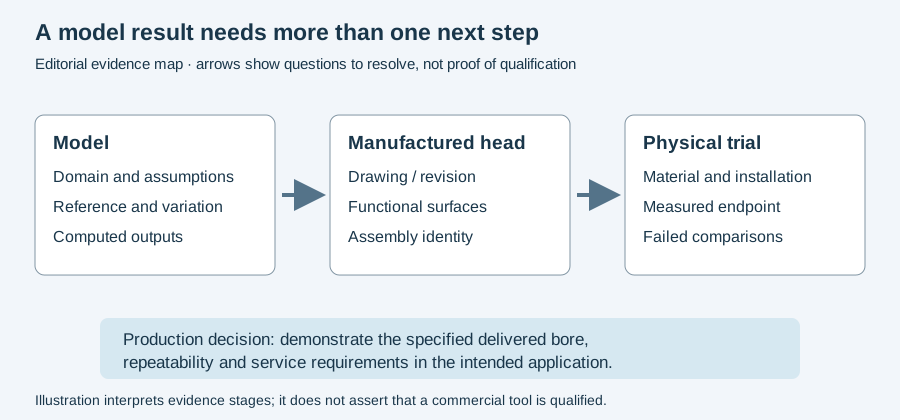
- Physical outcome: a measured result from the manufactured arrangement.
These are evidence categories, not an accuracy ranking between numerical methods. A method name cannot replace resolution, sensitivity or validation information in the actual study.
Manufacturing and testing add a different question
A prototype drawing, the manufactured functional surfaces and the assembled head need a common revision identity. A test of a changed physical configuration cannot validate an earlier model without making those changes visible.
In this investigation, the physical drilling comparison did not retain every simulated candidate as a successful design. The tested-head interpretation explains that outcome. This is why the evidence map below has separate stages rather than an arrow labelled “simulation proves production.”
Use the case worksheet to keep modeled, manufactured and measured states distinct. When the question becomes repeated delivery of a specified bore, continue to production-transfer requirements.
Revision note
October 8, 2026: revised the technical explanation and connected reading after source review. Original publication date and URL retained.