From ejector-drill research to an application trial
Rupasinghe and colleagues studied modified ejector drill heads through SPH simulation and experiments. The extended chip-mouth design reduced minimum stable flow under particular cutting conditions; the magnitude differs between tested speeds. See the study interpretation for the Table 3 conditions. This is a research result, not a commercial product specification. Full paper.
What would have to be demonstrated for production
| Question | Evidence needed |
|---|---|
| Does the head fit an existing system? | Drawings, connector/thread verification and supplier approval |
| Can it survive the intended duty? | Material, manufacturing quality, wear and fatigue evaluation |
| Does it improve this operation? | Matched trials with the actual material, tool and bore |
| Can flow be reduced safely? | Chip stability, cooling, pressure and system behavior across the cut |
| Is it commercially available? | Current product listing or supplier offer |
| Is it economical? | Quoted cost and measured energy/tool/cycle results |
Keep the research boundary visible
Lower minimum stable flow is different from lower normal operating flow, lower pump input power or lower total cost. A prototype result does not establish the launch date, direct replacement compatibility, price or payback of a future product.
Plan an evaluation
Start from the existing approved process and identify the exact change to be tested. Record chip blockage, bore quality, wear, actual coolant conditions and electrical input. Evaluate only a design supported by an appropriate supplier and application review; do not treat an experimental internal geometry as an approved field modification.
Read the research design overview and energy measurement guide for the separate questions.
Preserve the manufactured configuration
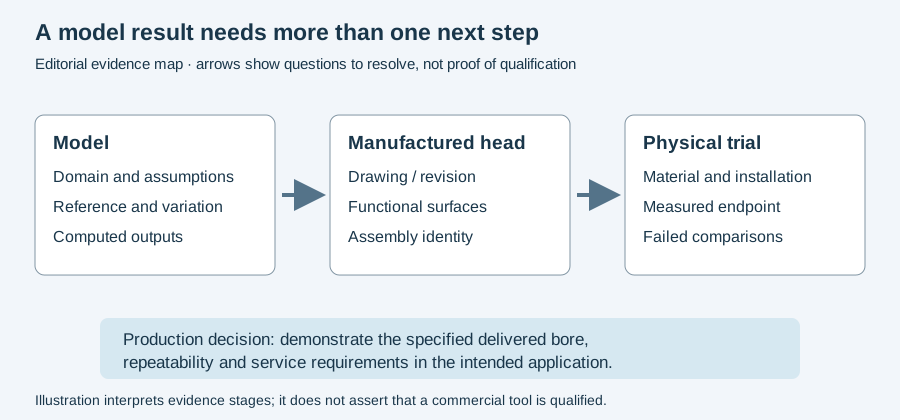
The research paper describes additive manufacture followed by machining of functional surfaces. A modified CAD head is therefore not the final supplied assembly. The production question concerns the configuration that will actually be made, inspected and operated.
Keep model revision, manufactured drawing, functional-surface inspection and assembled tool identity connected. If a design changes to permit assembly or service access, include the change in the comparison. A familiar product name cannot establish that it reproduces the studied configuration.
Separate prototype evidence from the proposed production endpoint. A test investigating stable chip evacuation answers a particular question. A delivery decision may also involve bore acceptance, service behavior, repeatability across supplied tools and the record package required by the customer. Define these questions before claiming the transfer is complete.
An original application case can document that next step when actual data and permission are available. Use the submission worksheet below to distinguish the studied design from the supplied version and retain unsuccessful comparisons. No commercial qualification is inferred from the paper’s existence.
Revision note
October 8, 2026: revised the technical explanation and connected reading after source review. Original publication date and URL retained.