Gun drill regrinding is a service on an identified cutting geometry. It is not one universal sharpening procedure for every head construction, diameter or peripheral form. Begin with the exact supplied tool and its applicable service documentation.
A published service has a defined scope
botek’s regrinding description lists both brazed-head and solid-carbide gun drills among its offered services. For other brands it asks for exact information on the nose grind. The page distinguishes regrinding from the combined regrinding/coating service.
That establishes offered work, not a guarantee that every damaged tool can be restored or that any one tool can be reground a fixed number of times. The actual condition and remaining permitted geometry belong to the service decision.
Nose grind and peripheral form are different
The botek catalogue, pages 15–17, discusses cutting-end geometry separately from head contour and guide surfaces. A nose-grind designation therefore does not by itself authorize work on the circumference.
Retain the intended nose geometry, peripheral form, diameter definition, working length and any special features. The supplied service instruction should identify which surfaces may be worked and how the returned state is checked. No grinding angles, wheel selection or pass sequence are prescribed here.
The returned state is more useful than “resharpened”
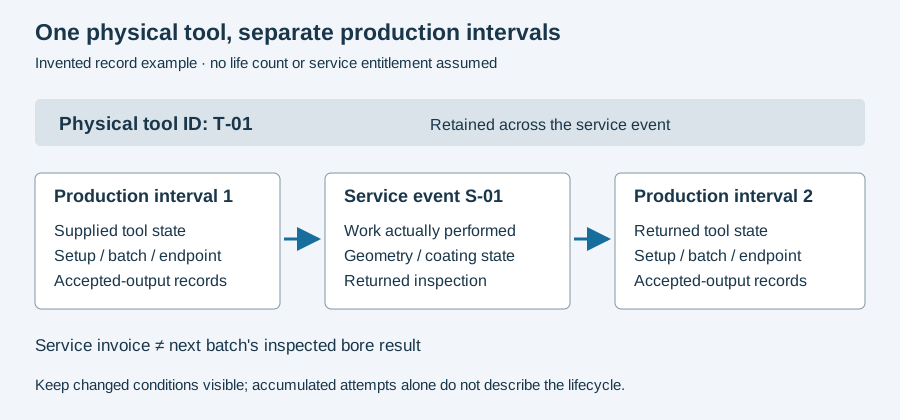
Request a description of the work actually performed and the inspection supplied with it. If length changes, retain the resulting tool identity and setup implications rather than treating the tool as geometrically unchanged. A recoat, repaired joint or other additional operation should remain separate in the record.
An illustrative return record might read “nose serviced to designation X, returned length Y, coating Z, inspection reference R.” X, Y, Z and R here are placeholders, not dimensions or a recommended specification. The purpose is to make the delivered state traceable.
Verify the next interval on its own evidence
Attach subsequent machining and bore observations to the service event. If a new entry bushing, fluid or program was introduced too, preserve those changes. A better result after several simultaneous changes does not isolate the regrind’s contribution.
For economics, assign service and release-work charges to actual accepted output from the chosen period. A lower service invoice alone cannot establish lower delivered cost if another charge or acceptance count is missing.
The interval diagram below shows how the records connect. Use the RFQ worksheet to state the service deliverable, then guide-pad contact for the separate circumference question or lifecycle management for successive production intervals.
Revision note
October 8, 2026: revised the technical explanation and connected reading after source review. Original publication date and URL retained.