Gun drilling materials are not interchangeable entries in a family-wide cutting chart. To interpret a recommendation, keep the grade and supplied condition with the tool series, diameter band and catalogue notes. A label such as “stainless steel” can conceal the distinction used by the actual source.
What one catalogue distinguishes
The botek German single-lip catalogue, printed page 10, gives guide values for Type 113 solid-carbide drills. Its columns distinguish steel below 900 N/mm², alloyed steel above 900 N/mm², a martensitic/ferritic stainless steel/cast-steel class labelled 13–25% Cr and sulfurized, and an austenitic stainless steel/cast-steel class labelled Ni > 8% and Cr 18–25%.
Those are the catalogue’s classifications, not a complete material taxonomy. A supplied grade and condition still need to be matched to the applicable entry. In particular, two materials described broadly as stainless steel should not be assigned one column merely because their family name matches.
Read across the correct diameter row
For the austenitic class on that page, vc is 30–40 m/min. The 2.0–2.49 mm diameter band lists fn=0.0050–0.0070 mm/rev. The adjacent 1.8–1.99 mm band has different feed values. Preserve the row and column together when copying data.
The catalogue calls these guide values and notes dependencies including drilling situation, tool length, fluid, material and setup stability. The chart is not evidence of achieved tool life or bore quality in an independently observed trial. Its edition date has not been established here; retain the exact PDF and obtain applicable current guidance for a production setup.
See the corrected speed/feed calculation for conversion of one scoped row into rpm and linear feed. That arithmetic checks units and transcription. It does not validate the chosen values on another tool construction, material or bore depth.
Make a material comparison interpretable
A useful trial record separates the material from changes introduced to machine it. If grade A uses one geometry and fluid while grade B uses another, a difference in outcome belongs to those complete tested combinations. It is not automatically a material-only result.
Our editorial comparison record would retain exact grade, supplied condition, specimen identity, bore requirements, tool configuration, fluid and settings for each run. Compare outcomes at the same inspected delivery stage and identify the service endpoint used for a tool-life statement. A tool replaced because of a particular bore defect has a different endpoint from one replaced on a fixed schedule.
Questions a family name cannot answer
“Which feed should I use for stainless?” leaves the catalogue class and tool unspecified. “Which material is easiest?” leaves the bore requirement, tested configurations and comparison measure unspecified. Replace each with the actual job question: what recommendation applies to this grade/condition and drill, or what do comparable documented trials show?
Where the source does not cover a proposed material, record that gap and obtain relevant guidance before selecting a nearby-looking entry. Keep coolant delivery and entry guidance visible in the setup, then retain inspected outcomes rather than presenting a family ranking without a common trial basis.
Compare the supplied condition, then the result
The botek catalogue separates material classes using composition and strength information. That classification matters when identifying a published starting range. It does not establish that two batches bearing a broad family name will behave identically.
For a comparison, identify the grade, supplied condition and the tool state alongside the selected catalogue cell. If those differ between runs, report the combined change. A higher accepted output may be useful operationally while leaving the individual contribution of material condition unresolved.
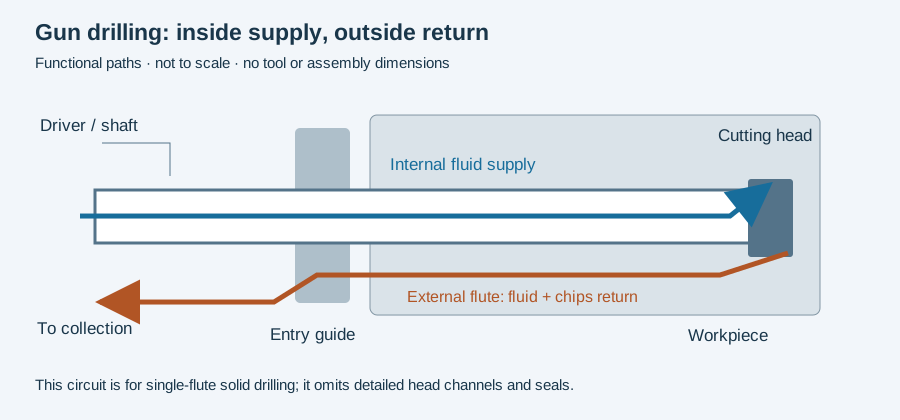
Specify the comparison endpoint as well. Entry diameter, exit location, inspected surface texture and accepted holes describe different results. A shorter cycle accompanied by an unmeasured bore interior does not establish improved bore quality. The diagram below connects the material choice to the fluid route; the next parameter article shows how a scoped input becomes a machine quantity.
Revision note
October 8, 2026: revised the technical explanation and connected reading after source review. Original publication date and URL retained.