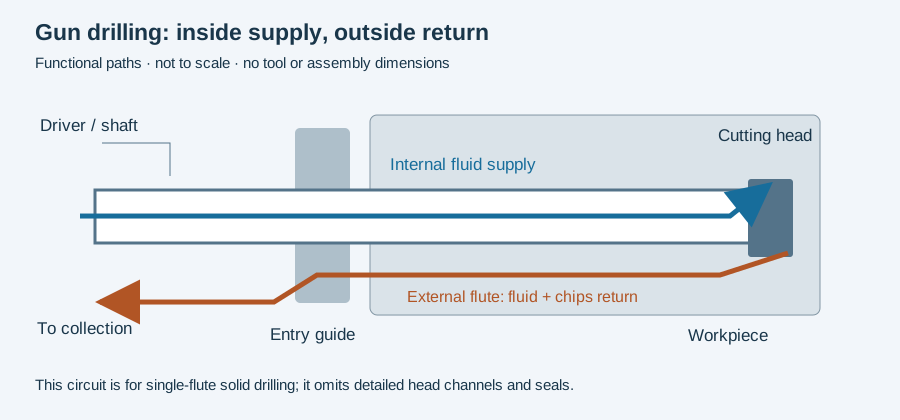
A gun-drilling coolant system supplies fluid through the tool and receives fluid and chips along the external flute. A pump rating describes one part of that circuit; it is not a measurement of every condition at the cutting head.
Give pressure and flow their locations
Gühring’s coolant FAQ discusses both pressure and delivered quantity. It describes PQ 3000 measurement with the actual tool clamped in the stationary spindle, so the measured arrangement includes the selected machine/tool configuration.
That is more specific than recording only a nominal pump setting. It also has a boundary: a stationary-tool check does not directly measure every condition during rotating cutting. Retain the instrument, measurement point, installed tool, fluid and test state with the result.
If two records show the same pressure but one lacks a flow measurement, they cannot be treated as identical delivery evidence. Likewise, a reading made at a different connection belongs to a different point in the circuit. The circuit diagram below makes the path explicit while leaving operating values unspecified.
Follow the return before specifying reuse
UNISIG’s machine overview separates collection, reservoir, pumping, filtration and temperature control. Returning chips need collection and separation; contamination remaining in reused fluid concerns filtration; heat concerns the temperature-control function.
Increasing a pump setting does not describe those other functions. Review which component a proposed change affects and what observation would show its effect. Keep the actual filter condition and fluid state with a delivery check if the comparison depends on them.
A fluid recommendation has a tool/application scope
Gühring’s FAQ and botek’s catalogue contain supplier-specific fluid guidance. They do not provide one instruction for every single-lip construction and material. This article therefore supplies no universal concentration, filter grade, tank volume or pressure.
A fluid review needs the named drill, cutting-data source, material condition and machine arrangement. Where an emulsified fluid or oil is proposed, retain the applicable supplier recommendation and the actual monitored condition. A liquid circuit also should not be conflated with a spray-mist arrangement.
Make an incident record usable
If a bore problem coincides with a changed delivery reading, retain the time and cutting position alongside chip/tool observations. The coincidence is evidence to investigate, not a proved cause by itself.
Use the incident worksheet for the sequence and competing explanations. Continue to low-pressure and spray-mist distinctions for different supply mechanisms, or troubleshooting for relating an observed condition to an actual machining event.
Revision note
October 8, 2026: revised the technical explanation and connected reading after source review. Original publication date and URL retained.