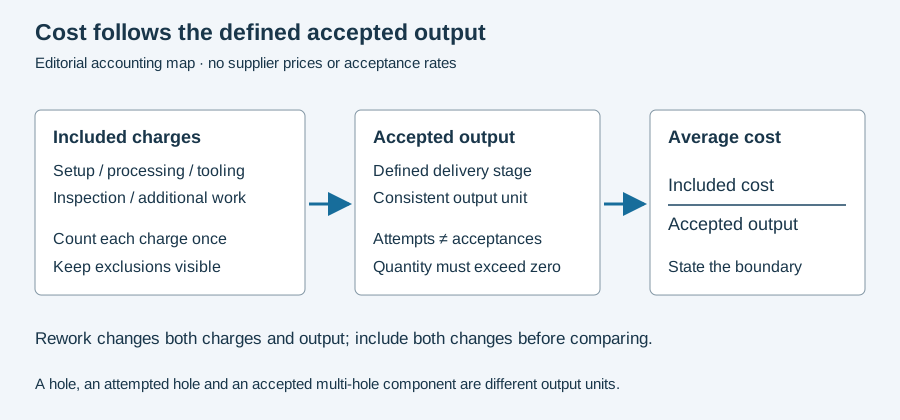
Gun drilling cost depends on what is delivered. A charge for machining an opening and a charge for an inspected, cleaned component describe different scopes, even if both use the same bore diameter and depth.
Establish the unit before the price
Use the controlled drawing, supplied blank, material condition, lot size and delivery stage as the common enquiry. Decide whether the comparison concerns holes or accepted components. A part with several holes does not become several independently accepted parts merely because each hole has a machining record.
Keep quotation, estimate and observed cost in separate fields. An expected acceptance count is an assumption until actual inspection supports it. The diagram below follows included charges to the defined accepted output; it contains no market-price data.
Keep charges from overlapping
| Group | Scope to establish |
|---|---|
| Setup and qualification | One-off preparation, repeat setup and trial inspection |
| Production | Cutting plus occupied machine/operator and handling time |
| Tooling | Purchase allocation, replacement, regrinding and coating |
| Delivery quality | Inspection, reporting, cleaning and finishing |
| Additional losses/work | Rework and rejected material not already charged elsewhere |
| Outside delivery | Subcontract operations, packing and freight |
A supplier piece price may already contain several groups. Adding them again creates double-counting. Retain exclusions alongside the total, rather than presenting a drilling-only amount as complete delivered cost.
An assumed batch calculation
Assume 100 attempted parts, 95 accepted parts and non-overlapping charges of 600 for setup, 2,400 for processing, 300 for tooling, 200 for inspection and 100 for additional rework. Assume blanks and freight are excluded. All figures are invented currency units for arithmetic.
1Included cost = 600 + 2,400 + 300 + 200 + 100 = 3,600
2Cost per accepted part = 3,600 / 95 = 37.89
3Cost per attempted part = 3,600 / 100 = 36.00
The results answer different questions. Neither is a price benchmark. An offer with a smaller total but fewer included delivery operations needs its exclusions resolved before ranking it.
Service cost needs service output
botek’s regrinding offer identifies a supplied service but does not give a cost or guaranteed accepted-part count for your drill. Retain the exact work, transport, returned inspection and any release work with its production interval. Do not assume a fixed saving or regrind count.
The RFQ worksheet below helps retain the delivered scope before comparing quotations. The separate cost calculator uses accepted holes as its output unit; do not enter a multi-hole component’s individual holes as independent acceptances if the comparison is actually by accepted part. Continue to cost-per-hole sensitivity for the arithmetic decision or regrinding for the tool-service boundary.
Revision note
October 8, 2026: revised the technical explanation and connected reading after source review. Original publication date and URL retained.