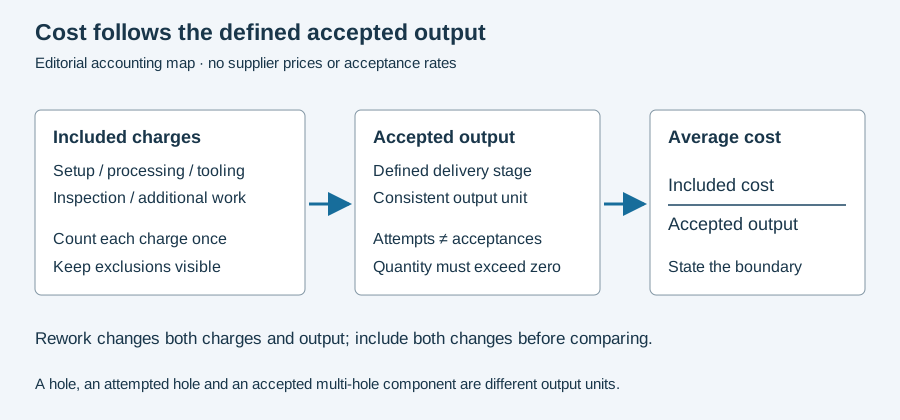
Gun drilling cost per hole needs a cost boundary and an output definition. An attempted hole, an accepted hole and an accepted multi-hole component are different denominators. This page uses accepted holes; the quotation guide establishes which charges belong to that boundary.
Separate attempts from accepted output
For included batch cost C and accepted-hole count N:
1Cost per accepted hole = C / N, for N > 0
Assume 100 attempts, 90 accepted holes and 900 currency units of included cost. The accepted-hole average is 10; the attempted-hole average is 9. These invented figures illustrate arithmetic, not measured yield or a market price.
The cost calculator below requires actual accepted output for a defined period. An empty acceptance field remains unresolved; zero accepted output does not produce a finite unit cost.
More accepted output can raise the average
Now assume additional rework costs 60 and creates five more accepted holes, with no other cost or count change. The new average is:
1(900 + 60) / (90 + 5) = 960 / 95 = 10.11
The accepted count rises, but the additional accepted output costs 60 / 5 = 12 per hole, above the previous average of 10. The whole-batch average consequently rises. This is an accounting comparison, not advice about whether the rework is technically or commercially appropriate.
Derive the comparison rather than guessing its direction
For positive C, N and additional accepted output ΔN, compare the new average with the old one:
1(C + ΔC) / (N + ΔN) < C / N
2is equivalent to
3ΔC / ΔN < C / N
Thus, under this defined boundary, additional output lowers the average only when its incremental cost per accepted hole is below the original average. Equality leaves the average unchanged. In the assumed batch above, five additional acceptances would lower the average only if the additional included cost were below 50.
This derivation assumes the stated costs and counts are complete and non-overlapping. If rework changes delivery charges, scrap recovery or another allocated item, include those changes before applying it.
Tool service uses the same boundary discipline
botek’s service description documents offered regrinding, not a guaranteed accepted output for the next interval. Allocate purchase/service charges once over the stated period and use its actual acceptances. A charge already included in a machine rate must not be added a second time.
Use the calculator to enter separate before/after scenarios; it does not predict ΔN. Continue to quotation scope for included charges or lifecycle management for connecting service events to actual intervals.
Revision note
October 8, 2026: revised the technical explanation and connected reading after source review. Original publication date and URL retained.